Georgina Energy, a helium, hydrogen and natural gas exploration and development company with strategic permits in Australia, has advised that due to delays in mobilising the Ensign Rig 970 to site, the company has decided to implement a new seismic program, subject to regulatory approvals to conduct additional non-invasive seismic over the Hussar Prospect which will be fully funded by Harlequin Energy.
A review of the geophysical attributes of vintage seismic over the Hussar Prospect by Distinguished Emeritus Professor, Dr Brian Evans, of Curtin University, has revealed the interpreted presence of 'Direct Helium and Hydrogen Indicators' (“DHHIs”) where they are manifested as 'bright spots, phase reversals or gas chimneys.' (https://geoexpro.com/acquiring-seismic-data-for-oil-exploration-in-1980-but-using-it-to-find-hydrogen-now/)
As a result of the delays in mobilising the Ensign Rig 970 to site caused by adverse weather conditions and road closures to heavy vehicles the Company has designed a c.350 km seismic survey over the Hussar Prospect to further and more accurately delineate the DHHIs interpreted by Professor Evans and to provide even more clarity over the all important salt sealing layer overlying the main Townsend and fractured basement target zones.
The seismic is planned to not require heavy vehicle access by utilising the very latest state of the art light weight seismic techniques and equipment that are environmentally non-invasive.
Such equipment will not require any clearing or grading of seismic lines nor extended geophone cables but will use carefully modulated vibration sources able to be mounted on light weight rubber tyred or crawler tractors. This equipment will also utilise newer generation nodal ecosystems utilising integrated Bluetooth Low Energy (BLE) or wireless transceivers for contactless, daily data harvesting.
The seismic programme will take approximately 30 days field work and will take place subject to Western Australian Department of Mines, Petroleum and Exploration and Traditional Owner cultural heritage approvals expected to be issued shortly.
This programme is also designed with a view to efficiently expedite rapid field development with multiple wells into production and export subject to commercial discovery success.
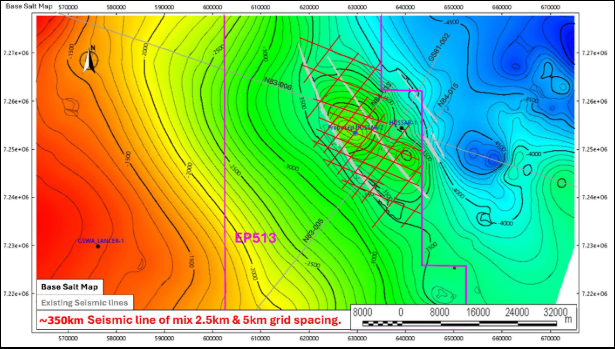
Planned c.350 line km of new seismic Hussar Prospect
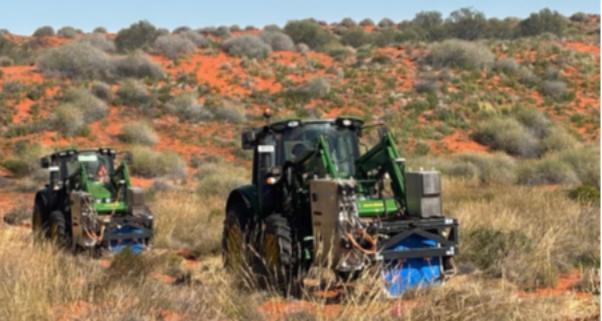
Lightweight non-invasive seismic vibration source
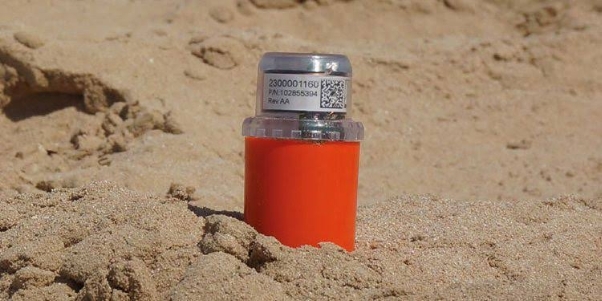
Cable free Bluetooth seismic node (geophone)
The Hussar EP513 prospect re-entry in Exploration Permit 513 in the Officer Basin in Western Australia is primarily targeting subsalt reservoir formations, including the Townsend Formation and fractured Neoproterozoic basement lithologies, for helium, hydrogen and natural gas and is planned to drill to a Total Depth of approximately 3,200m which may be extended depending on gas occurrences and reservoir quality. Globally, fractured basement reservoirs similar to that targeted in the Hussar Prospect, have proven to be prolific producers. The Bach Ho field in fractured basement offshore Vietnam for example, at its peak produced 1.6 BCFGE (billion cubic feet of gas equivalent) per day and has been in continuous production for over 40 years. (https://www.saltworkconsultants.com/downloads/Bach_Ho_Cuong_Warren_09.pdf)
A secondary target is the hydrocarbon gas potential in the Kanpa and Hussar formations overlying the primary subsalt targets. These formations have not been adequately tested to date but have shown excellent porosities and hydrocarbon shows during previous drilling.
The Hussar prospect has an Independent Geological Report dated 1st February 2026 by Competent Person Mr Maki Petkovski certifying unrisked SPE PRMS (the Society of Petroleum Engineers and Petroleum Resource Management Systems) net attributable 2U Prospective Resources of 283 BCF helium, 315 BCF hydrogen and 2.93 TCF of hydrocarbon gas.
Based on the pricing of Helium US$450/MCFG and Hydrogen US$2.65/kg and US$8/MCF for hydrocarbon gas, these volumes would equate to a total potential combined net attributable unrisked potential in-situ value of c.US$152 billion. These are estimates in-situ values from the AER (Australian Energy Regulator) and HNT (Helium Price Index) developed by the Company based on unrisked prospective resources; they exclude production, separation and transport-to-market costs, and there is no certainty that any part of these resources will be commercially recovered.
Further updates will follow as we progress towards a revised spud date along with additional site photos which can be viewed by shareholders on the Georgina website.
Anthony Hamilton, Chief Executive Officer of Georgina Energy, commented:
'This seismic programme was originally planned as a post drill program but due to weather and road closures will provide multiple benefits in not only amplifying Direct Helium and Hydrogen seismic indicators but also in potential full field development. Of this exciting prospect and we look forward to making further announcements in due course'.
Source: Georgina Energy