Barbados has officially opened a new offshore licensing drive, inviting international energy companies to bid on 19 ultra-deepwater blocks. The launch of the 2026 Offshore Petroleum Direct Negotiations creates a three-month window for proposals to explore for oil and natural gas in the island’s waters. Acting Prime Minister and Minister of Energy, Business Development and Commerce, Kerrie Symmonds announced that the pre-qualification period will run until September 1.
The new offshore push is part of a broader multi-energy strategy designed to balance energy security and economic resilience with Barbados' ongoing renewable energy commitments.
Companies that qualify will be eligible to seek exclusive negotiations for 62,643 sq km of combined offshore acreage, including continental shelf and deepwater areas. The available blocks range in size from 1,167 sq km to 5,007 sq km. Exploration licences will be valid for up to eight years and include commitments related to local content, environmental research, workforce training, health and safety.
The potential economic windfall for Barbados is substantial. Director of Natural Resources, Jamar White reported that years of seismic surveys and technical assessments suggest the presence of massive offshore reserves. Preliminary estimates point to upwards of 13 billion barrels of oil and more than 40 trillion cubic feet of natural gas.
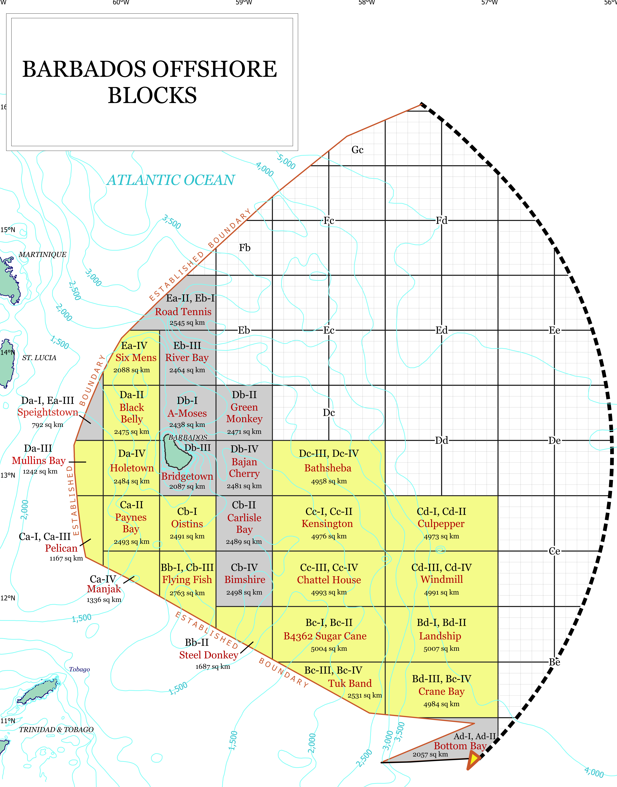
Despite this potential, the government has slightly scaled back the scope of the offering. While 22 blocks were offered during the 2022 bid round, the current tender features only 19. According to Symmonds, this reduction is a deliberate policy choice to hold back the remaining blocks for the future development of the country’s own national energy company and related domestic interests.
Companies that successfully pass the initial vetting phase will be issued a qualification notice, officially recognizing them as suitable operators for Barbados' ultra-deepwater environment.
The government aims to finalize direct negotiations with pre-qualified companies by January 15, 2027. Following this, recommendations will be submitted to the Cabinet for final approval.
However, a successful bid does not mean immediate drilling. Before any exploration can commence, awarded companies must undergo a comprehensive Environmental Impact Assessment (EIA) process. This includes collecting baseline environmental data, outlining operational methods, and identifying strategies to mitigate impacts on local wildlife and conservation efforts.
Source: Energy Chamber of Trinidad and Tobago