Petrobras and Seatrium held a christening and sailaway ceremony for the P-80 and P-82 offshore platforms this Thursday (August 27th) at the Tuas Boulevard Yard shipyard in Singapore. The units will operate in the Búzios field, in the pre-salt layer of the Santos Basin, the largest field in reserves and production in Brazil.
The units are in the final phase of module integration and will sail to Brazil in the coming weeks. The P-80 (Búzios 9) will be the first to leave the shipyard. Production of both units is scheduled to begin in 2027 .
Each platform has the capacity to produce 225,000 barrels of oil per day, one of the largest capacities in the global industry. The units can also process 12 million cubic meters of gas per day each .
'These are two giant platforms for our giant Búzios field. They comprise a new cycle of six high-capacity production units, initiated with the FPSO Almirante Tamandaré, which operates in Búzios above its design capacity, with record production of 270,000 barrels of oil per day. Following the P-80 and P-82, we will complete the P-83, P-84, and P-85, which will go to the Búzios, Atapu, and Sépia fields, respectively. We expect to achieve production exceeding 225,000 barrels per day in all these units,' said Petrobras President Magda Chambriard during the event in Singapore.
In addition to record production capacity, the plants will utilize technologies and digital solutions that ensure greater operational and energy efficiency.
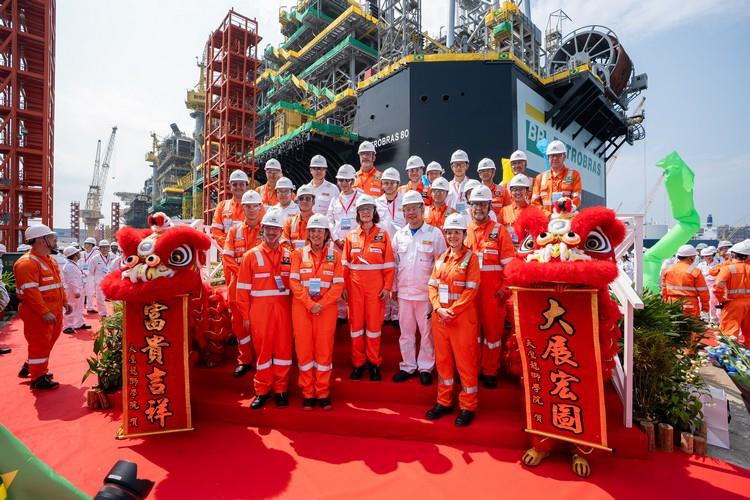
Photo: President Magda Chambriard and her entourage during the christening of the platforms in Singapore
Construction
The construction of the platforms was contracted by Petrobras under the EPC ( Engineering, Procurement, Construction and Commissioning ) model, in which the contractor is responsible for the engineering, procurement, construction and commissioning of the unit until its delivery for operation in Brazil.
The P-80 process modules were manufactured in Brazil, at the Seatrium BrasFELS shipyard in Angra dos Reis; and the P-82 modules at the Seatrium Aracruz shipyard in Espírito Santo, contributing to workforce qualification and generating employment and income through the shipbuilding industry in Brazil. In addition, constructions took place in China, Singapore, and Indonesia. Subsequently, these modules were transported to Singapore for final integration, from where they depart for the start of production in Brazil.
Source: Petrobras