A key technology for optimizing oil production and exploring new frontiers is aligned with decarbonizing operations. Production takes place at the Camaçari Technology Park, at SENAI-CIMATEC.
OBN OD technology records seismic waves propagated and reflected in oil reservoirs throughout seismic campaigns which, processed by supercomputers, improve prediction in new exploratory frontiers.
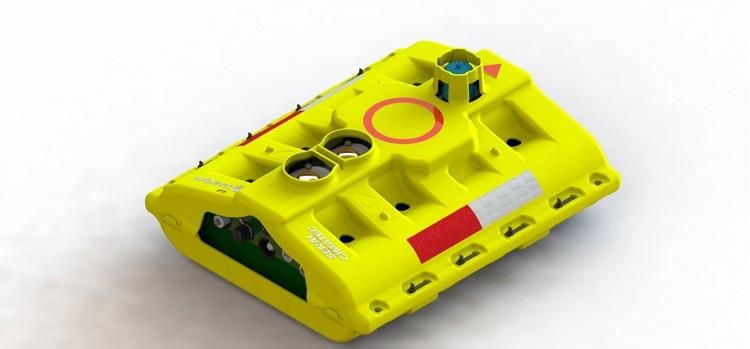
Petrobras is beginning, for the first time in Brazil, the manufacture of on-demand ocean bottom nodes (OD OBN), used for seismic monitoring of offshore fields, especially in the pre-salt layer. Until now, the company had relied exclusively on imports of this equipment to map the geological layers of the subsurface. OD OBN production is taking place at the Camaçari Technology Park in Bahia, at SENAI-CIMATEC, in a project developed in partnership with Shell and Sonardyne and with support from the ANP (National National Agency for Petroleum and Natural Resources). Sonardyne, the equipment manufacturer, has employed approximately 60 Brazilian workers since July of this year at the new production plant, located in one of the country's main technology centers.
For the past two decades, Petrobras has used 4D seismic to optimize new well drilling in regions with no production (increasing the recovery factor), especially in the Campos and Santos basins. 'Innovations like this keep the company at the forefront of technology in the industry, with operations in pre-salt fields with low carbon emissions,' says Renata Baruzzi, Petrobras' Director of Engineering, Technology, and Innovation.
The acquisition of geophysical data allows a detailed study of the marine subsoil, highlighting its geological characteristics, the structure of the sedimentary layers, the presence of faults or fractures and possible mineral or energy resources.
Much of the equipment developed in Brazil for the OBN OD nodes was pioneering and uses technology unprecedented in Latin America, and is expected to boost the manufacture of high-precision seismic sensors. The research and development phase lasted almost seven years.
The Brazilian prototype has already been tested in the Búzios field, in ultra-deepwater Santos Basin, with promising results. Petrobras invested approximately R$200 million, approximately half the total project cost. The expectation is to manufacture 660 seismic nodes by February 2026.
What is OD OBN seismic?
OD OBN technology records seismic waves propagated and reflected from oil reservoirs during seismic campaigns. These waves, processed by supercomputers, improve predictions for new exploration frontiers, the positioning of injection and production wells, the volume recovered, and the sustainability of producing oil fields. With these subsea nodes, 4D seismic imaging acts as an X-ray of the Earth's interior at different points in time, opening up new perspectives for producing fields.
State-of-the-art 3D (characterization) and 4D (monitoring) seismic facilitates the discovery of new deposits, maps fluid displacement and pressure variations in reservoirs, increases operational safety, and reduces costs. By reducing the operating time of nodes, which remain on the seabed for up to five years, this technology also reduces the environmental impact of offshore seismic operations, both in terms of fossil fuel consumption and greenhouse gas emissions.
Ideal for deep waters, 4D seismic, unlike traditional methods, reduces interference and improves image quality.
Source: Petrobras