- Completion of equity transactions for TenneT Germany secures foreseen equity needs of TenneT Germany. TenneT Holding will hold a strategic minority stake in TenneT Germany.
- Progress on strategic grid expansion projects, bringing new infrastructure into operation in the Netherlands and advancing critical energy hub developments in Germany.
- Solid financial results in H1-2026, expected grid investments lower than 2026 forecast.
- Continued challenges on permitting and securing space for development put further pressure on execution timelines, while TenneT is working with stakeholders on an acceleration package.

Financial Results
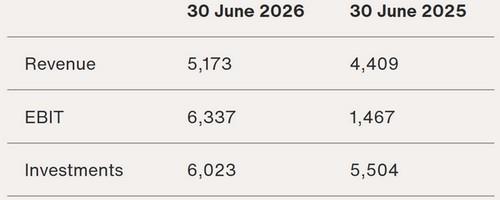
Underlying revenue in the first half-year of 2026 increased by EUR 764 million to EUR 5,173 million (H1-2025: EUR 4,409 million). In the first half-year of 2026, revenue mainly increased because of TenneT's growing investments, resulting in a growing regulatory asset base and higher onshore and offshore revenue and increased regulatory rates.
In the first half-year of 2026, underlying EBIT increased by EUR 4,870 million to EUR 6,337 million (H1-2025: EUR 1,467 million). The increased EBIT is mainly driven by a one-off gain of EUR 4,627 million on the deconsolidation of TenneT Germany, following the remeasurement of TenneT's remaining equity stake in TenneT Germany. This was partly offset by the EUR 133 million gain recognised in 2025 on the sale of two participations. Without taking into account these transactions, EBIT increased from EUR 1,334 million in H1-2025 to EUR 1,710 million in H1-2026, mainly due to revenue growth, partly offset by increased depreciation and amortisation.
TenneT continued to make critical investments in the onshore and offshore grid, ensuring a secure and reliable supply of electricity, while facilitating the energy transition. TenneT invested EUR 6,023 million in the grid in the first half of 2026 (H1-2025: EUR 5,504 million). The full year 2026 investments are expected to be lower than planned for. This is primarily due to a shift in investments in the offshore 2GW Program caused by the termination of the contract with Petrofac, an engineering and construction contractor, and the transition to the replacement contractor, Larsen & Toubro. This has resulted in investments for related offshore projects shifting from 2026 to 2027.
Key underlying results (in EUR million)
Commenting on the results, Dieuwert Inia, Chief Financial Officer of TenneT Holding and TenneT Netherlands, said: 'We delivered a solid financial performance in the first half of 2026 and continue to push ahead with critical projects and unlocking flexibility to expand electricity infrastructure and increase grid capacity. These investments are essential for easing congestion and ensuring security of supply.'
Equity transactions for TenneT Germany completed
On 30 June 2026, TenneT Holding reached an important milestone with the closing of the equity transaction for TenneT Germany and the payment of the first equity tranche of EUR 2.5 billion by institutional investors APG, GIC and NBIM. This is part of their total commitment of up to EUR 9.5 billion in TenneT Germany, which is to be contributed over time. In addition, on 3 July 2026 TenneT Holding completed the sale of a 25.1% stake in TenneT Germany to Kreditanstalt für Wiederaufbau (KfW), acting on behalf of the German government, for EUR 3.3 billion. Together, these investments significantly strengthen TenneT Germany’s capital base and provide a solid foundation for financing the expansion of Germany’s high-voltage grid, making these transactions a solid example of a public-private partnership. As a result of these equity transactions, TenneT Holding is expected to dilute to a minority stake of 28.9% in TenneT Germany over time. Per 3 July 2026, TenneT Holding has 28.9% of the voting rights, resulting in a loss of control per 30 June 2026. The net proceeds resulting from KfW’s direct purchase of shares enabled TenneT to repay in July 2026 EUR 3.3 billion of the shareholder loan provided by the Dutch state.
Manon van Beek, Chief Executive Officer of TenneT Holding and TenneT Netherlands, said: 'The successful completion of these transactions provides a strong foundation for the investments needed in the years ahead. Across the Netherlands and Germany, we face an important task to expand and modernise the grid. Delivering this challenge depends not only on financing and infrastructure, but above all on the people who make it possible every day. As we continue to accelerate investments, it remains essential that everyone involved in our projects and operations, our own employees as well as those of contractors and subcontractors, returns home safely every day. Maintaining the highest safety standards across the entire sector will remain one of our top priorities.'
Key events Netherlands in the first half of 2026
Substantial work continued on key grid infrastructure projects in the Netherlands. In Zuid-Holland near Rotterdam, the Zuidplaspolder substation came into service, while work also progressed on the Maasvlakte to connect three new offshore wind farms. In addition, the next construction phase of the Rilland–Tilburg high-voltage connection commenced, linking Zeeland and Noord-Brabant.
TenneT made further progress in utilising the Dutch grid better by unlocking additional capacity through innovative flexibility solutions. In Noord-Brabant, a 200 MW battery project was contracted. In the Northern Netherlands, 307 MW of capacity was made available under flexible arrangements with solar parks. In Zeeland, a further 260 MW was unlocked, enabling 173 new or expanded connections.
As the pressure on the electricity grid becomes more evident, TenneT warned in February 2026 of a potential connection pause in Flevopolder, Gelderland and Utrecht (FGU) and called for coordinated action. Thanks to intensive cooperation and clear agreements between national and regional stakeholders, a general pause has been averted.
In March 2026, TenneT Netherlands successfully issued its first EUR 2 billion Green Bond under the new funding structure supported by an irrevocable and unconditional institutional guarantee from the Dutch State. Supported by the Dutch state guarantee, this issuance attracted strong investor interest.
In June, the Supervisory Board of TenneT Holding B.V. nominated Frans Everts as the new CEO and Chair of the Executive Board of TenneT Holding and TenneT Netherlands. The Ministry of Finance subsequently appointed him for a four-year term, effective 1 November 2026. His appointment follows the succession process that began earlier in 2026 in anticipation of the end of current CEO Manon van Beek’s second and final term in August 2026. Van Beek will remain in her role until her successor takes office, ensuring a smooth handover in the months thereafter.
Key events Germany in the first half of 2026
In January, construction began on the HeideHub in Northern Germany, one of Europe’s first multiterminal hubs. This pioneering project will feed large amounts of wind power into the electricity grid and enable efficient transport to high-demand regions in Southern Germany. By integrating DC and AC networks, it will reduce congestion, strengthen security of supply and is a central component of a future meshed DC grid. TenneT Germany is working on the project alongside 50Hertz and SH Netz.
Also in January, TenneT Germany and National Grid announced a partnership to develop GriffinLink, a new multi-purpose interconnector (MPI) connecting British and German offshore wind to both countries. GriffinLink would be among the first projects of its kind in Europe and a milestone for cross-border energy security and stability.
In February, TenneT Germany and other German TSOs announced new procedures for grid connection applications from battery storage facilities and other large consumers. Such applications will be evaluated on verifiable criteria, including the probability of implementation. This replaces the first-come, first-served approach, in which grid connection applications were processed based on the date of submission.
In April, TenneT Germany officially began construction on a new energy hub in Sengwarden, near the northern German port of Wilhelmshaven. The site will be a crucial hub for connecting 4 GW of offshore wind power into the onshore grid – enough to supply around five million households with electricity.
Source: Tennet