
New analysis highlights the geological factors that can lead to commercial success as interest returns to the Atlantic margins
New analysis from Westwood Global Energy Group (Westwood), the specialist energy market research and consultancy firm, highlights the challenges of bringing exploration success in South Atlantic post-rift Cretaceous plays to market, with technical discoveries not consistently translating into commercial success.
The study comes as the appetite for exploration across the Atlantic margins increases, with Westwood data showing that half of acreage taken by the supermajors since the start of 2025 has been in the South Atlantic. However, while the technical success rate from exploration drilling across the region remains high, the chance of a discovery leading to a commercial development is significantly lower, highlighting the need to identify the geological parameters that can lead to a commercial success.
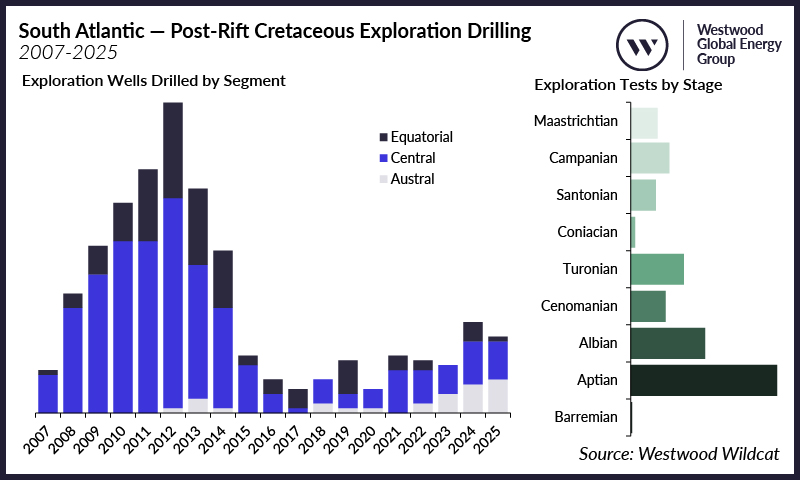
Westwood’s South Atlantic Margin Study analyses 425 exploration wells targeting post-rift Cretaceous stratigraphy drilled between 2007 and 2025, assessing performance across the Equatorial, Central and Austral segments of the South Atlantic. The study combines Westwood’s well data and analysis with palaeogeographies plus structural and crustal domain data from Getech, a leading subsurface and geospatial insight provider for the natural resources sector.
The research shows that across the study dataset, whilst the exploration technical success rate is significantly higher than the global average, less than a third of those discoveries leads to a potentially commercial development. Key findings include the importance of an effective source rock at local and basin scale, the influence of depositional slope type and palaeo-slope angle on resource density, and the role of reservoir provenance and palaeo-drainage area in shaping exploration potential.
The analysis points to a region of major opportunity, but one where success has been sporadic. Exploration drilling peaked in 2012, following success at Jubilee and Brazilian pre-salt plays, before falling sharply following the oil price crash of late 2014. Since 2021, activity has cautiously returned, with more than 10 wells drilled per year.
Graeme Bagley, Head of Exploration & Appraisal at Westwood, said: 'Post-rift Cretaceous exploration across the South Atlantic has delivered some of the most significant exploration successes of the past two decades, but the data shows that technical success alone is not enough. Commercial outcomes depend on a specific set of geological factors that impact the fluid quality, resource density and reservoir deliverability. As companies assess the next wave of acreage and drilling opportunities, understanding those parameters will be critical to identifying potentially commercial opportunities.'
Max Brouwers, Chief Business Development Officer at Getech, added: 'Exploration performance across the South Atlantic has varied significantly between basins, plays and margin settings, so understanding the wider geological context is critical. By combining well results with palaeodepositional environments, palaeobathymetry, geologic structure and crustal domain data, this study provides important regional context for understanding those variations and the geological factors that have shaped exploration outcomes.'
Further information on Westwood’s South Atlantic Margin Study is available here.
Source: Westwood Global Energy Group