
A visit last month to Offshore Norge’s annual conference in Oslo was a powerful reminder that despite a shared history of developing offshore resources in the North Sea over the past fifty years, the UK and Norway are now on very different trajectories – driven by policy not geology.
Accompanied by OEUK Head of Communications Tim Warnes, we found ourselves in the unusual surroundings of an indoor skate park in downtown Oslo which had been temporarily converted into a venue for 500 people from Norway’s energy sector. We were there to listen to industry leaders and a range of prominent Norwegian politicians – including centre-left Labour Prime Minister Jonas Gahr Støre, and the leaders of the Centre Party, Conservative Party, and the populist Progress Party.
It’s just over 700 miles as the crow flies from Westminster to Oslo. But listening to Norway’s political leaders from across the political spectrum addressing the makeshift auditorium, one after the other speaking proudly of the offshore oil and gas sector, the distance between the UK and Norway when it came to energy policy felt a lot further. Instead of polarisation and ideology provoking fierce disagreement and policy flux, pragmatism and consensus was the order of the day, providing a firm foundation for the energy sector and confidence to investors.
There was, quite understandably, repeated recognition from the stage of the importance of homegrown energy production for Norwegian economic growth. While UK production has dwindled in recent years due to fiscal and regulatory challenges, production from the Norwegian Continental Shelf has continued to underpin Norway’s economy. However, the arguments advanced from political leaders were not focussed purely on economic self-interest, there was instead an understanding of how oil and gas produced in Norway was critical for energy security – and ultimately national security – for the whole of Europe, including the UK.
After the twin shocks of the Russian invasion of Ukraine and now war in Iran, the supply of homegrown oil and gas from the North Sea is more critical than ever. As the top two producers in the region and with the phase out of Russian supply, Norway and the UK have an important role to play in underpinning energy security in Europe. While Norwegian policymakers have grasped this, much work still needs to be done in Westminster and Whitehall to ensure the same appreciation of the North Sea’s importance.
No one denies that after fifty years of production, the North Sea is a mature basin. But there remain many billions of barrels of oil and gas on both sides of the maritime border – resources that can reduce reliance on imports from outside Europe. This is not about increasing consumption of oil and gas, this is about ensuring that for as long as oil and gas is consumed, it is better that as much of this is produced domestically – for the sake of the economy, jobs, skills, industrial resilience, energy security and lower carbon emissions.
The story of the past decade is one of divergence between Norway and the United Kingdom. According to latest data from Rystad, in 2015, investment was broadly similar, with upstream capital expenditure totalling $21bn in Norway and $18.8bn in the UK. Fast forward a decade to 2025 though and in Norway it had increased to $24.2bn but as a result of fiscal and regulatory conditions, slumped to just $5.5bn in Britain. Almost three-quarters (73%) of the Norwegian capex was in the North Sea. After being close to parity at the turn of the millennium, Norway produced over three times as much oil and gas as the UK last year.
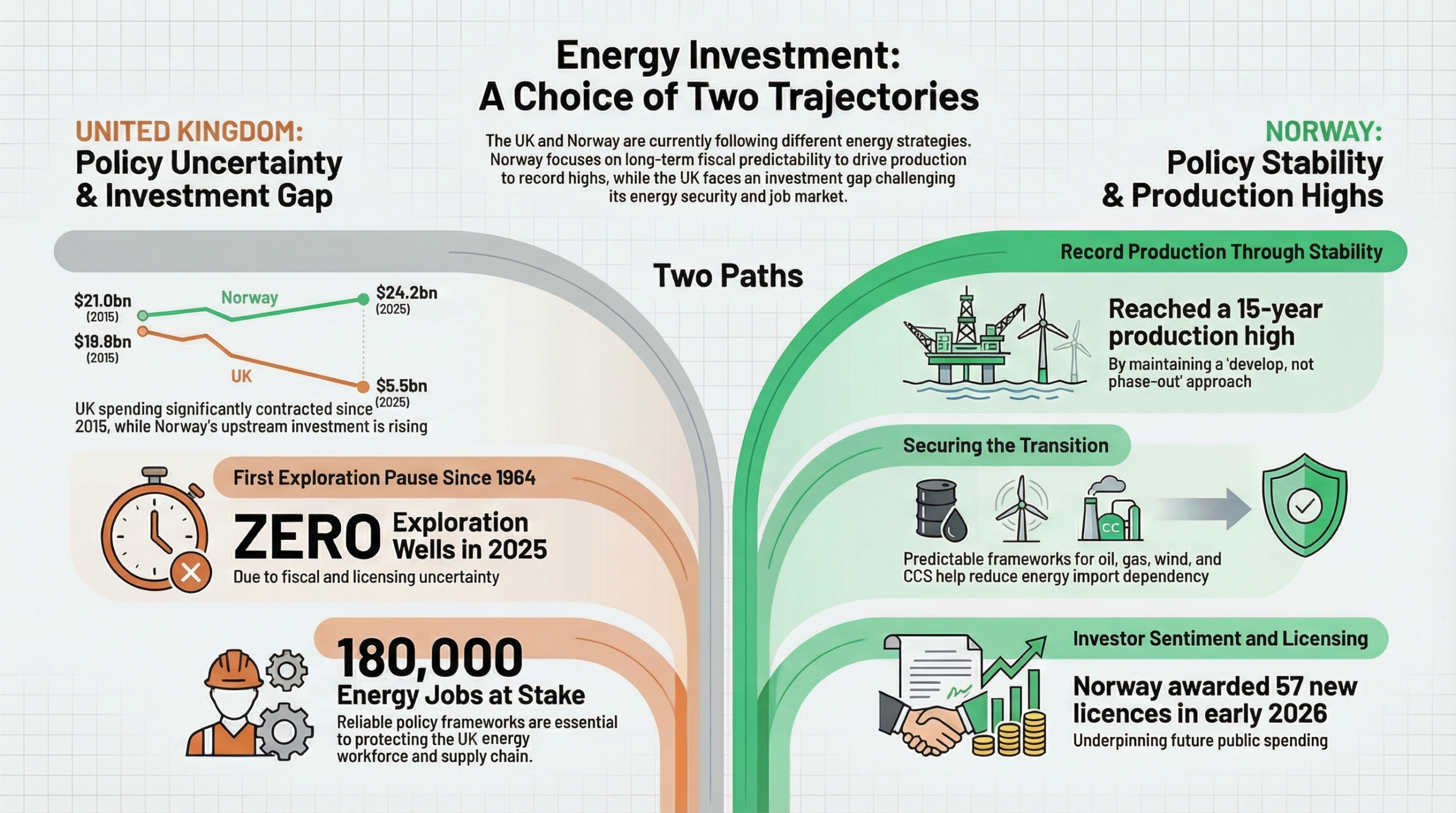
With 57 new offshore licences issued in January this year, Norway continues to seek new opportunities for production and extend the life of existing fields. Overall production is expected to be maintained at a similar level over the next decade, while in the UK, with the Energy Profits Levy still on the books and a ban on new exploration in place, production will keep declining without fiscal and regulatory reform.
Events in the Middle East over the past six weeks have exposed our energy security vulnerabilities. The DESNZ Gas System in Transition: Security of Supply consultation – with its sanguine tone towards increased reliance on LNG imports – now looks strangely anachronistic, overtaken by the pace of geopolitical events. Norway shows that a stable fiscal and regulatory regime, cross-party support for energy policy, and a deep understanding of the contribution to regional energy security, is a success story that continues to attract investment. It’s not too late for the UK to follow suit.

Source: OEUK