Reconnaissance Energy Africa, along with its partners BW Energy (20% WI) and the National Petroleum Corporation of Namibia ('NAMCOR', 10% carried WI), have announced preliminary production testing results from the three zones in the Huttenberg formation on the Kavango West 1X ('KW1X') discovery well, along with plans to advance to open-hole horizontal production testing.
Highlights
- Successfully flowed natural gas and potential liquids to surface from two separate zones from the KW1X discovery well;
- The upper Huttenberg flowed natural gas and potential liquid content to surface;
- Upper Elandshoek flowed hydrocarbons to surface (previously disclosed);
- Vertical production testing at KW1X is now complete; and,
- Huttenberg formation has been prioritized for an open-hole horizontal production test, targeting up to 1,000 metres of horizontal section.
Huttenberg Formation Results
The uppermost zone of the Huttenberg formation flowed natural gas and potential liquid content to surface immediately upon perforation, ahead of any acid stimulation, and was flared through the relief flare stack. Flow rates were not measured from the Huttenberg due to previously disclosed equipment limitations, which has been rectified for the upcoming open hole horizontal production test by way of procuring the necessary equipment, which is currently being shipped to site, and by changing the surface operations service provider at site. Production samples, including both natural gas and potential liquid content have been collected in several IsoTubes with results of the compositional analysis expected in the coming weeks from samples sent to laboratories in the United States.
This test result completes vertical production testing operations at KW1X. Surface testing equipment associated with the vertical program has been stood down and demobilized as the Company prepares for the next phase of operations.
Advancing to Open-Hole Horizontal Production Test
Having flowed natural gas and potentially liquids to surface from two separate zones at KW1X, the next stage of success-based testing is to proceed with an open-hole horizontal production test in the uppermost zone of the Huttenberg formation, with an option for an additional horizontal test in the uppermost zone of the Elandshoek formation.
The Huttenberg formation was selected for the initial horizontal test based on:
- Flow of natural gas and potential liquids to surface;
- 75 metres of pay identified from original well log analysis;
- Presence of matrix porosity between large natural fractures;
- Longer horizontal lateral section due to being approximately 600 metres shallower than the Elandshoek;
- The Jarvie-1 rig is expected to drill up to 1,000 metres of horizontal section through the Huttenberg formation.
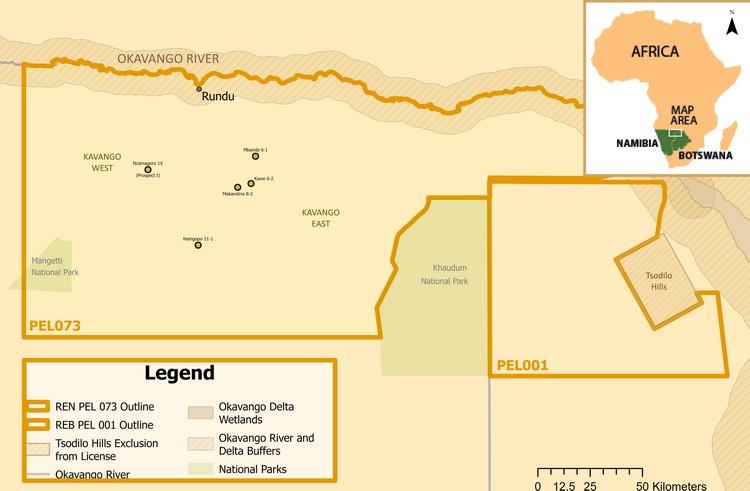
Brian Reinsborough, President and CEO, commented: 'We are excited to report another critical milestone of the KW1X production test, which is achieving our primary objective of proving the flow of hydrocarbons to surface, this time from the uppermost zone of the Huttenberg formation. The vertical cased-hole phase of testing at KW1X is now complete and with the significant data and technical information gathered from this test, we have a high level of confidence moving forward with an open-hole horizontal production test in the Huttenberg formation.
Importantly, KW1X's well results do not just validate a single structure; it also opens running room across the block. We have mapped 22 structures using existing seismic data and anticipate the inventory could grow with additional seismic coverage on PEL 73. We also believe our acreage in Angola could add additional structures to our inventory. These results have made critical steps to derisk and open a new play fairway.
Confirming the KW1X results with a flow rate test on a horizontal sidetrack as soon as possible will ultimately support resource and reserve bookings and a final investment decision on this emerging Damara Fold Belt Play.'
From Vertical to Horizontal: The Path Forward
The purpose of the vertical production testing program was to determine which parts of the reservoir, if any, could flow hydrocarbons to surface. It was not to determine flow rate as cased vertical wells are not the optimized development design for this fractured reservoir. Phase one production testing achieved a critical milestone; the program established two of the six zones of interest identified in the well contain hydrocarbons capable of flowing to surface. This does not preclude the other sections from flowing hydrocarbons via a more optimized horizontal open hole completion.
The next step, an open-hole horizontal production test in the upper Huttenberg zone, is designed to establish a representative flow rate over a large, exposed reservoir section uninhibited by production casing, cement and perforations. An open-hole horizontal well is required to achieve maximum reservoir penetration and optimal fracture intersection, consistent with the natural fracture orientation observed in the reservoir. Horizontal development of the Damara Fold Belt structures is also expected to reduce surface land disturbance as well as the number of wells required per structure, resulting in lower field development costs and improved capital efficiency.
Formation imaging log (FMI) analysis from wells drilled through the Otavi reservoir indicates fracture density ranging from 1.0 to 12.7 fractures per metre (P90–P10), with fracture orientation running parallel to the fold structure. The current well design contemplates a horizontal lateral of up to 1,000 metres to optimally intersect these natural fracture swarms. Completing the well open hole, without casing or cement, is intended to maximize flow from fractures. These fractures have inclinations of 50-90 degrees, with most fractures being vertical, to near vertical. The horizontal well will be drilled perpendicular to the fracture orientation. Open fractures in analogue carbonate fields enhance permeability and often link matrix porosity with the reservoirs.
Next Steps - Continuous Operations
The Jarvie-1 rig remains on location to drill the horizontal sidetrack laterals. To ensure the best possible outcome from the planned horizontal test, ReconAfrica has procured two high pressure pumps, a swabbing unit and additional supporting equipment in the United States which is currently being shipped to site for the continuation of the production testing operation. Routine rig maintenance is currently being conducted as the Company awaits the delivery of equipment and receipt of necessary permit amendments before the resumption of drilling operations. ReconAfrica has contracted H2OIL to conduct surface operations and provide additional surface equipment, including an appropriately sized separator unit. Halliburton will continue to provide downhole equipment and services.
The Company continues to advance permitting and preparations of the Kavango West 2A ('KW2A') appraisal well. Once the horizontal production test at KW1X is complete, the partners plan to move to drill a horizontal well and conduct an open hole horizontal production test at the KW2A appraisal well location to establish reservoir extent and communication.
Source: ReconAfrica