
Production outpaces resource growth on the NCS. Resource report 2026: Without significant discoveries, production on the Norwegian continental shelf (NCS) may fall steeply after 2030. Resources remain plentiful, but growth levels are too low to maintain current production levels over time.
The resources remaining on the NCS are estimated at approximately 7 billion standard cubic metres of oil equivalent (scm oe). Around half of these resources have not yet been discovered. By comparison, approximately 9 billion scm oe. have been produced and delivered.
Oil and gas production declines naturally as reservoirs become depleted. To maintain production levels, the companies must invest continuously in new wells and in other measures designed to improve recovery.
If the NCS is to continue to create value and contribute to future energy security, we need more discoveries. We also need to optimise utilisation of the resources already discovered and bring discoveries onstream faster. This is a key message from the 2026 resource report prepared by the Norwegian Offshore Directorate. The report illustrates that developments on the NCS up to 2050 require targeted efforts in multiple areas simultaneously.
'The decisions we make today will determine the Norwegian continental shelf´s trajectory over the coming decades. The discoveries made in recent years are too small to replace production from the fields in operation,' says Kjersti Dahle, Director of offshore new ventures.
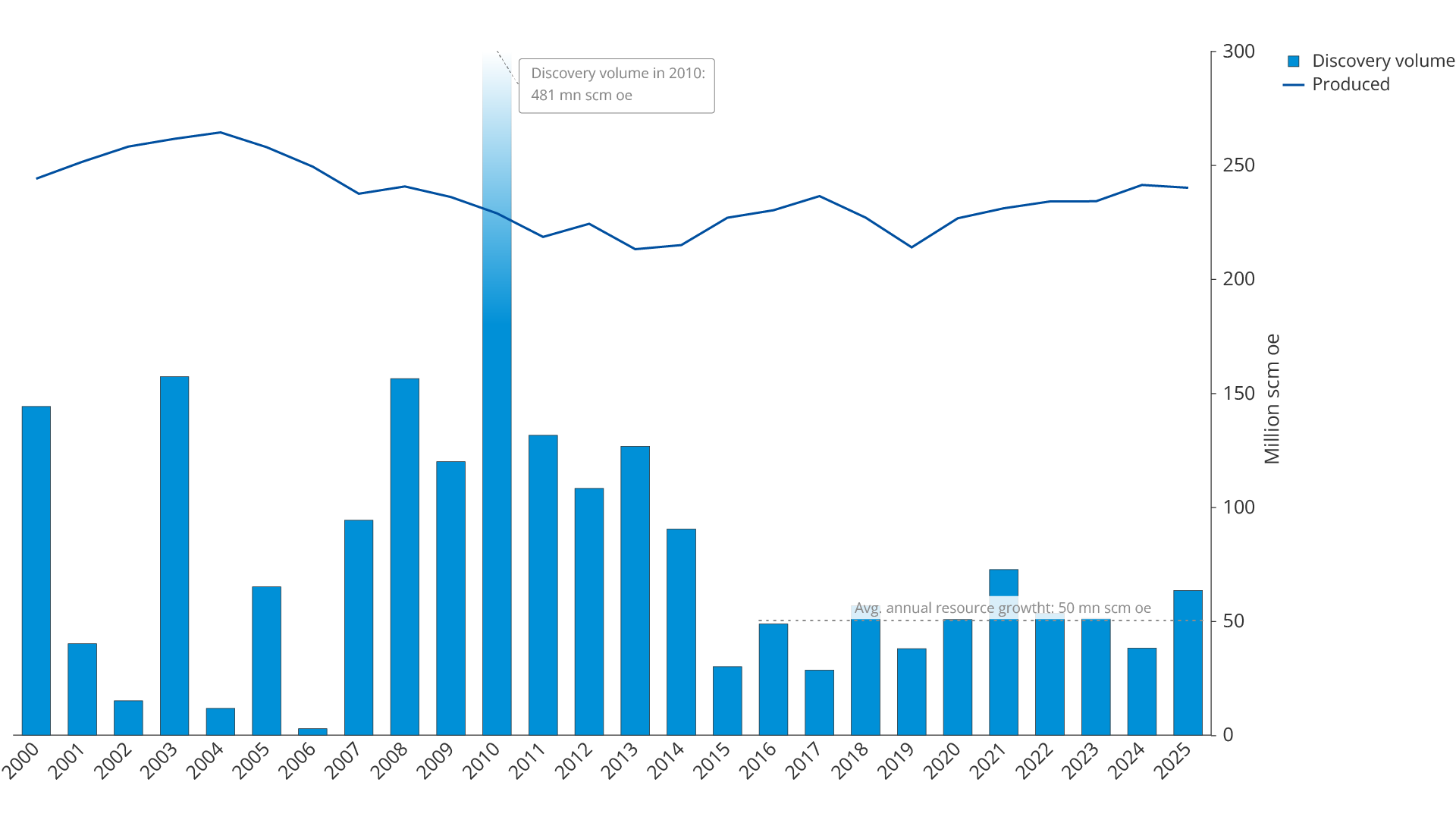
Figure: Volume of discoveries from exploration (incl. RC6) since 2000. Average resource growth over the past 10 years stands at just 50 million standard cubic metres of oil equivalent.
Low resource growth makes the decline in production inevitable
The decline in production has been highlighted for many years. Historically, large discoveries, new developments and enhanced recovery have helped to curb the decline. Resource growth over the past decade has been so low that the drop in production is no longer a future challenge. It is becoming a reality. By making simultaneous investments across the entire resource base, we can delay and constrain this decline.
For Norway, this is about much more than volumes. Slow growth today means a steeper fall post-2030. This in turn translates to less value creation, fewer jobs, weaker energy security for Europe, and diminished government revenues. If these contributions are to be sustained over time, resource growth must increase.
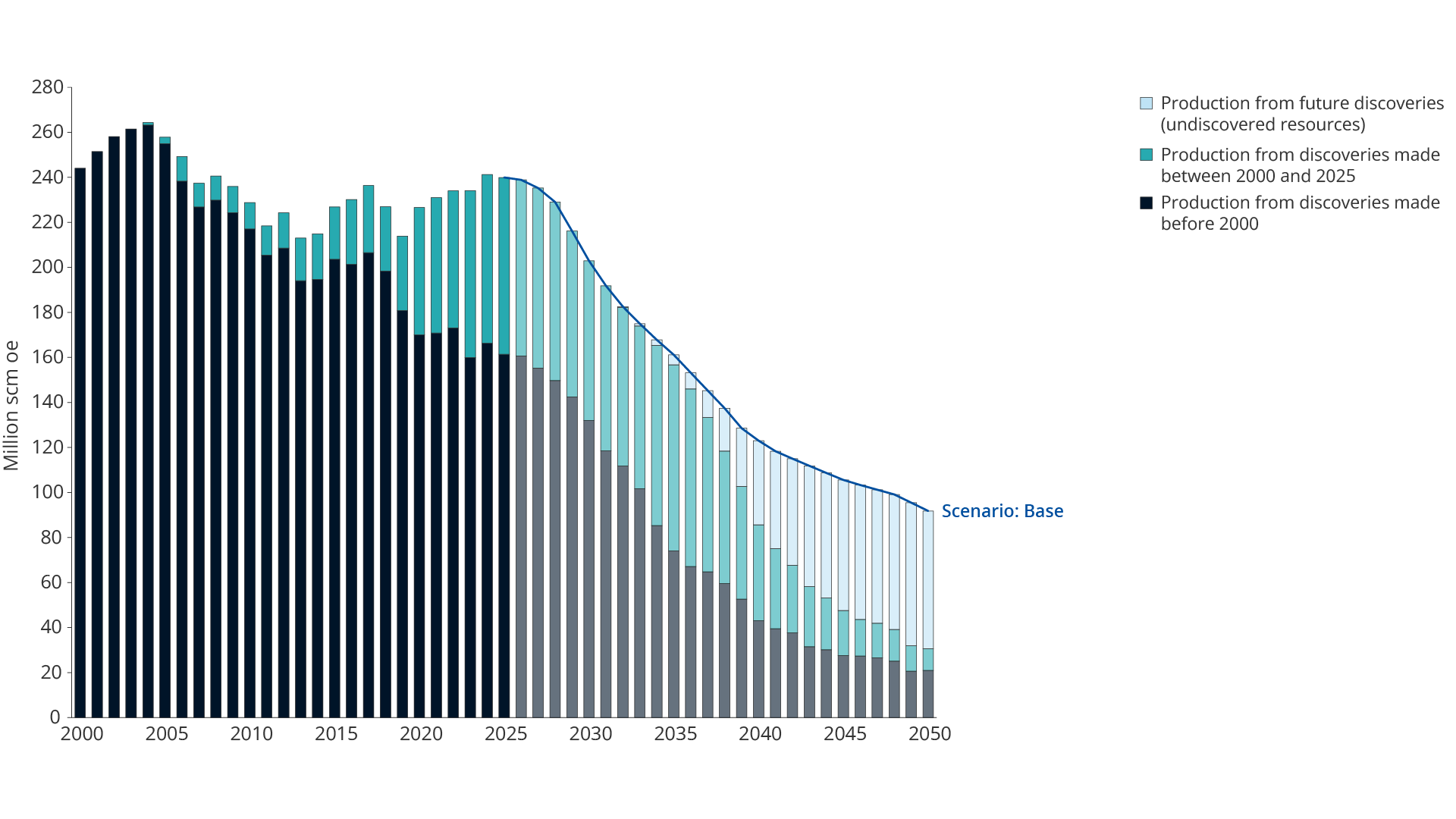
The figure illustrates that exploration activities on the NCS in the period 2000–2025 have been crucial to maintaining a high level of production. New discoveries have added resources which counteract the decline in production from mature fields, and a large proportion of future production will come from resources proven during this period.
Slower, but steeper
Short-term measures can delay the decline, but make it steeper if we fail to simultaneously identify new resources in the future.
Production has been higher than expected over several decades. This is, inter alia, due to large fields such as Ekofisk, Oseberg and Statfjord having produced higher volumes over a longer period than originally assumed.
As reservoir knowledge and understanding have gradually increased, companies have succeeded in extending the lifetime and increasing recovery from these fields. For the newer fields, the potential is smaller. When these were brought onstream, both recovery technology and knowledge of the subsurface and reservoirs had improved. The potential for increasing recovery rate and significantly extending field lifetime is therefore smaller than for many of the mature fields.
In the short term, swifter field development can curb the decline in production by picking up the pace from discovery to production. Such measures can bring production forward in time and accelerate value creation. However, they do not address the fundamental issue, which is that resource growth is too low. The right conditions must be put in place to enable larger discoveries and to avoid an excessively sharp drop in production, value creation and government revenues.
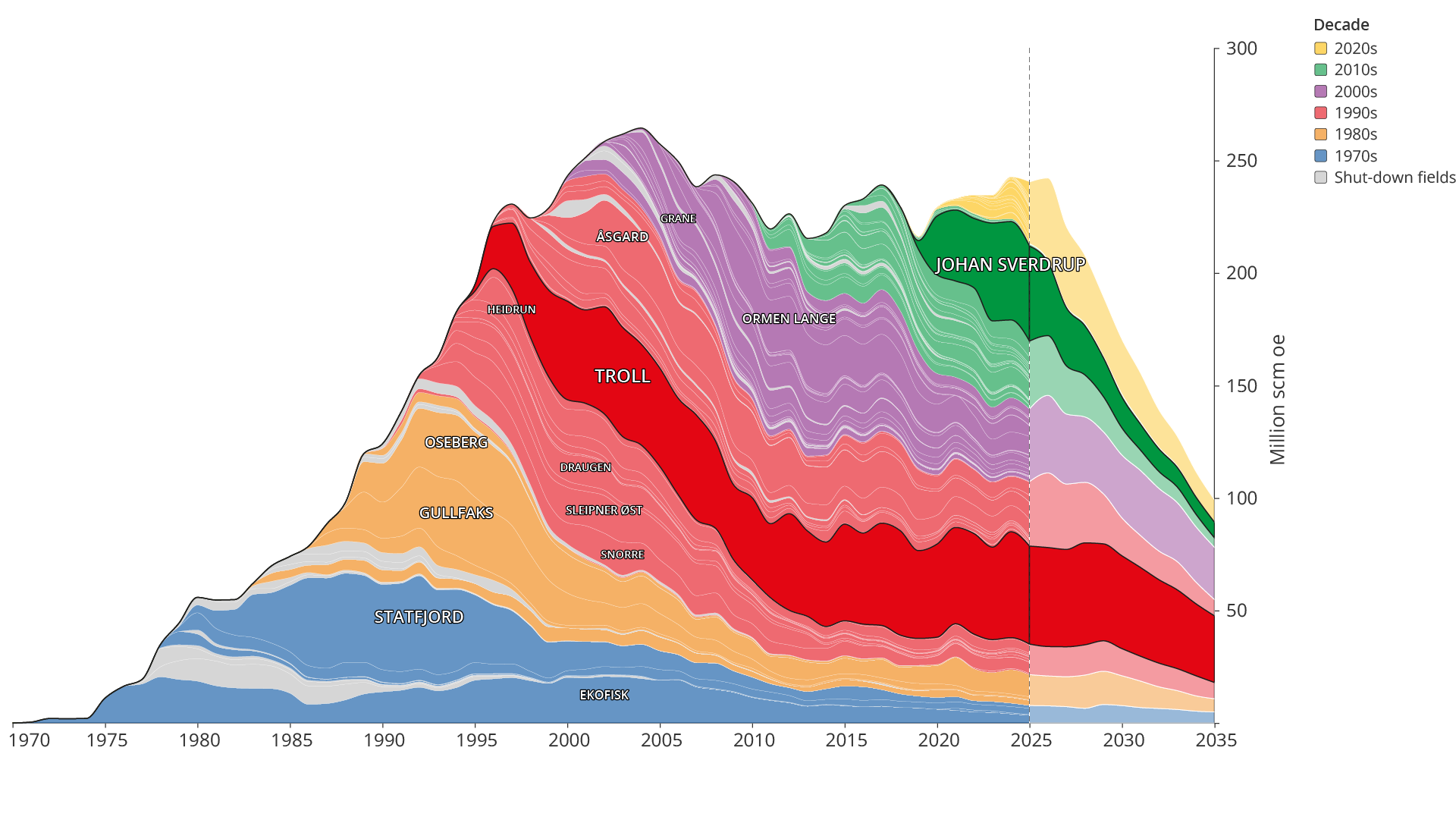
The figure shows that several large fields contributing majorly to total production, such as Troll and Johan Sverdrup, will plateau rapidly post-2026.
Plenty left to discover
Our estimates show that approximately half of the remaining resources have not yet been discovered. We have very limited or no knowledge about the resources in certain areas of the NCS. Such areas are either excluded from the resource accounts, or the resource base is estimated conservatively. More mapping, more data and more exploration are essential to improve knowledge about these resources and strengthen the basis for long-term production.
According to the resource report, exploration on the NCS has been extremely profitable. Over the past 25 years, one krone spent on exploration has returned four kroner.
Today, most exploration activity is carried out in mature areas, close to existing infrastructure. Discoveries in such areas are significant because they help to keep existing fields in operation, which in turn enables the development of new resources and further exploration.
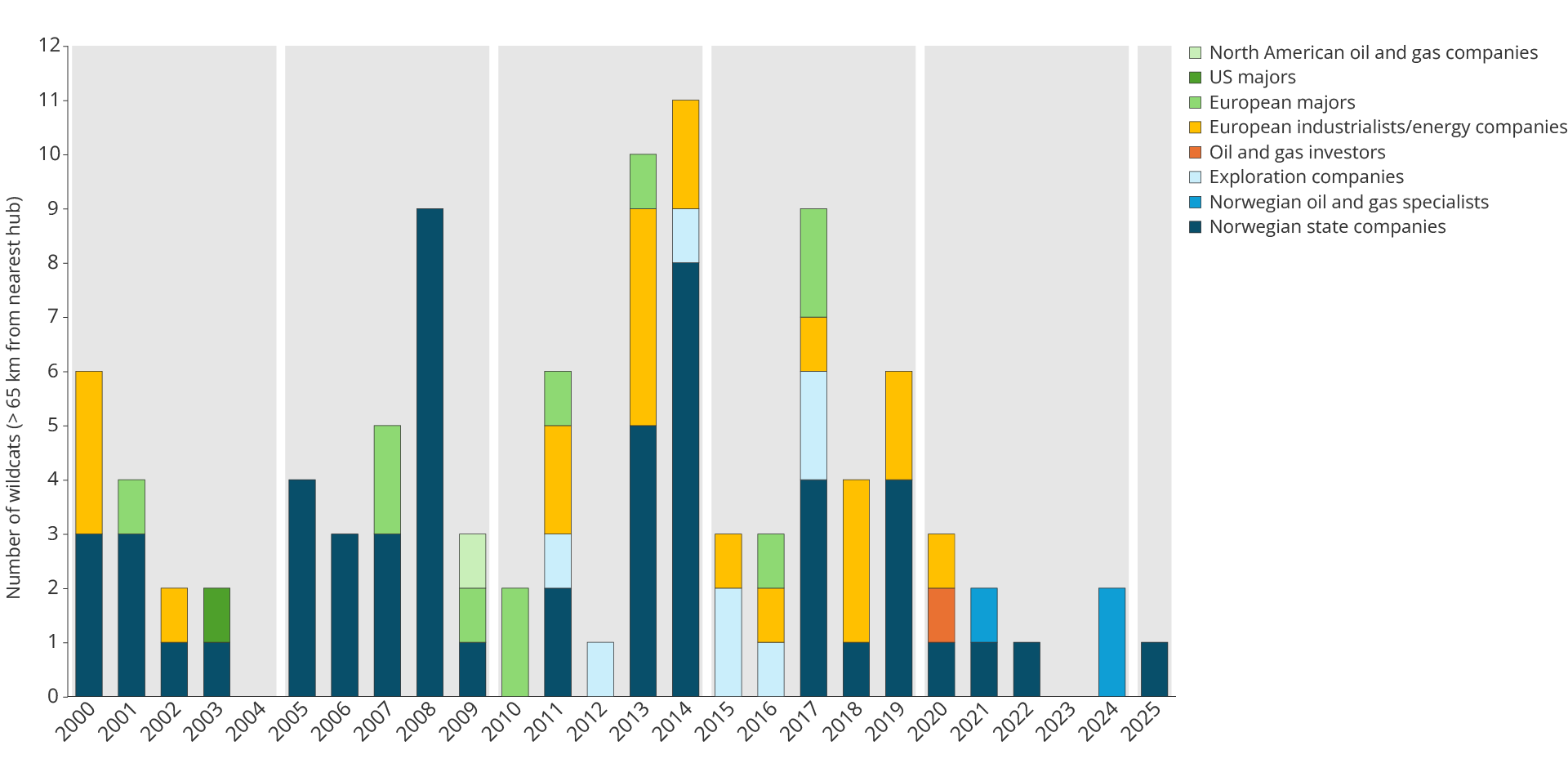
Figure: Exploration wells spudded > 65 kilometres from existing infrastructure, by company category.
This has resulted in many smaller discoveries, but nowhere near enough new resources to sustain production over time. Larger discoveries than the average over the past ten years are needed.
Increased knowledge and access to new exploration areas can increase the probability of new and larger discoveries.
New discoveries require new knowledge
Without major discoveries such as Johan Sverdrup and Johan Castberg, production levels on the NCS would have been far lower today. Both discoveries are prime examples of how the use of technology, combined with creativity and risk appetite, can yield major discoveries outside the most established plays, where knowledge of the subsurface is scarcer than that of the most familiar areas.
The High North has the largest resource potential remaining on the NCS. Large areas of the Barents Sea remain underexplored. More mapping, more data and further exploration are thus required to minimise uncertainty, clarify the nature of the resources present, and establish whether they can be developed.
Discoveries need to be brought on stream more swiftly
Over 90 discoveries on the NCS are awaiting development decision. Many are small and need to be tied back to existing infrastructure to become profitable. The longer the wait time, the greater the risk that the infrastructure is shut down and the resources remain in the ground.
When a discovery is tied back to a facility, it increases production and distributes the fixed costs. It may also extend the life of the host field and facilitate the recovery of more resources.
A shorter timespan from discovery to production thus secures the resources in the discovery and enhances production from the tie-back field.
How will NCS production look like in 2050?
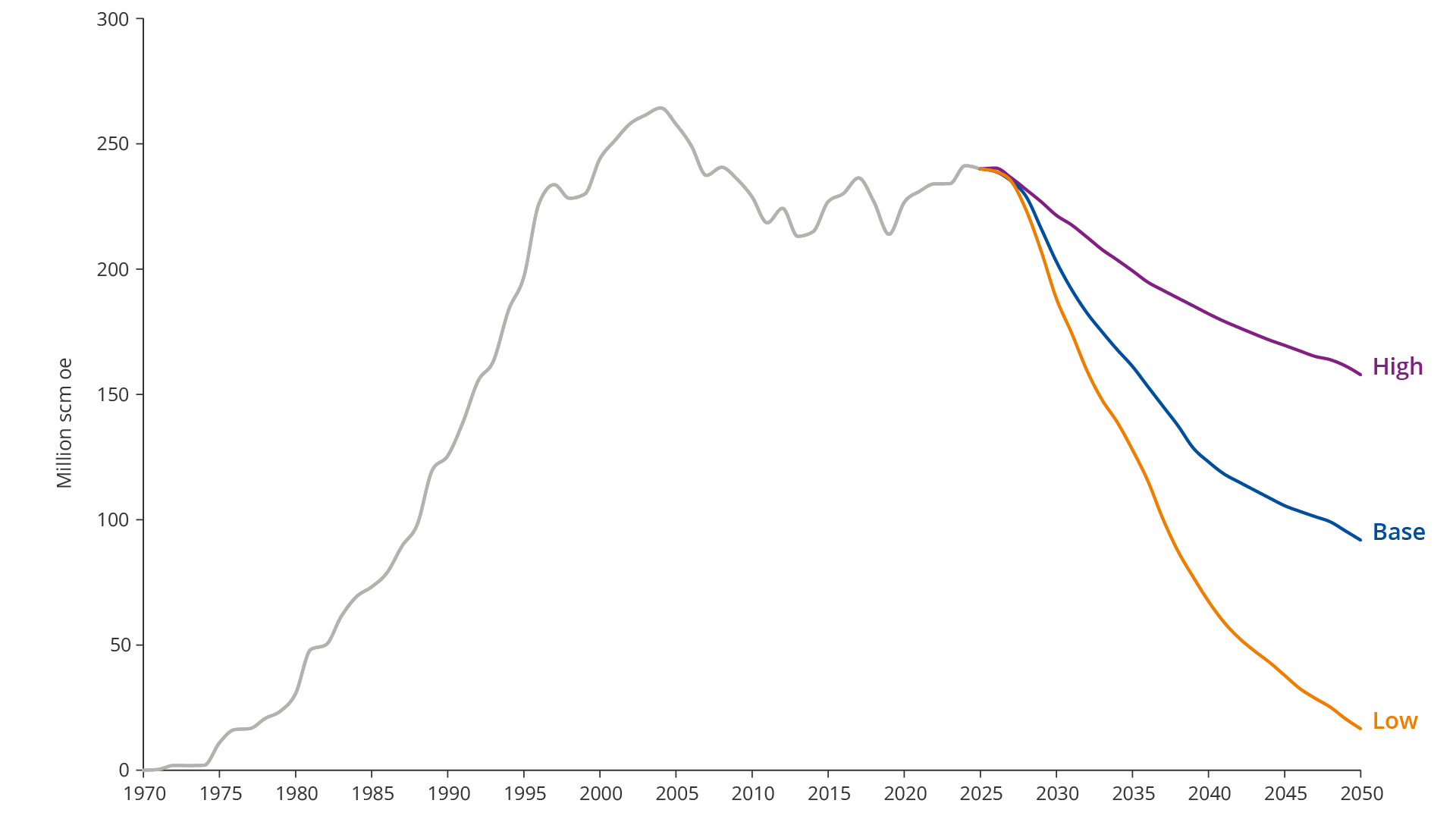
The figure shows three possible scenarios for the development of production on the Norwegian continental shelf up to 2050.
The resource report outlines three possible outcomes for production up to 2050. All three illustrate a decline over time, but the pace and scope vary widely. The difference lies in exploration, technology, investments, swifter development of discoveries, and development and utilisation of infrastructure.
In the High scenario, production in 2050 could equate to approximately two-thirds of current levels. In the Low scenario, production in 2050 could plummet to almost zero.
The three scenarios are not symmetrical. Without concerted effort, developments are more likely to drift towards the low level. Keeping production at the Base level or High level requires sustained effort.
The Low scenario is largely due to inaction. Multiple negative development trends can have a cumulative effect: less use of infrastructure, fewer companies and loss of expertise. Once this type of spiral has become established, it is both difficult and costly to break, as demonstrated by experience in other mature areas.
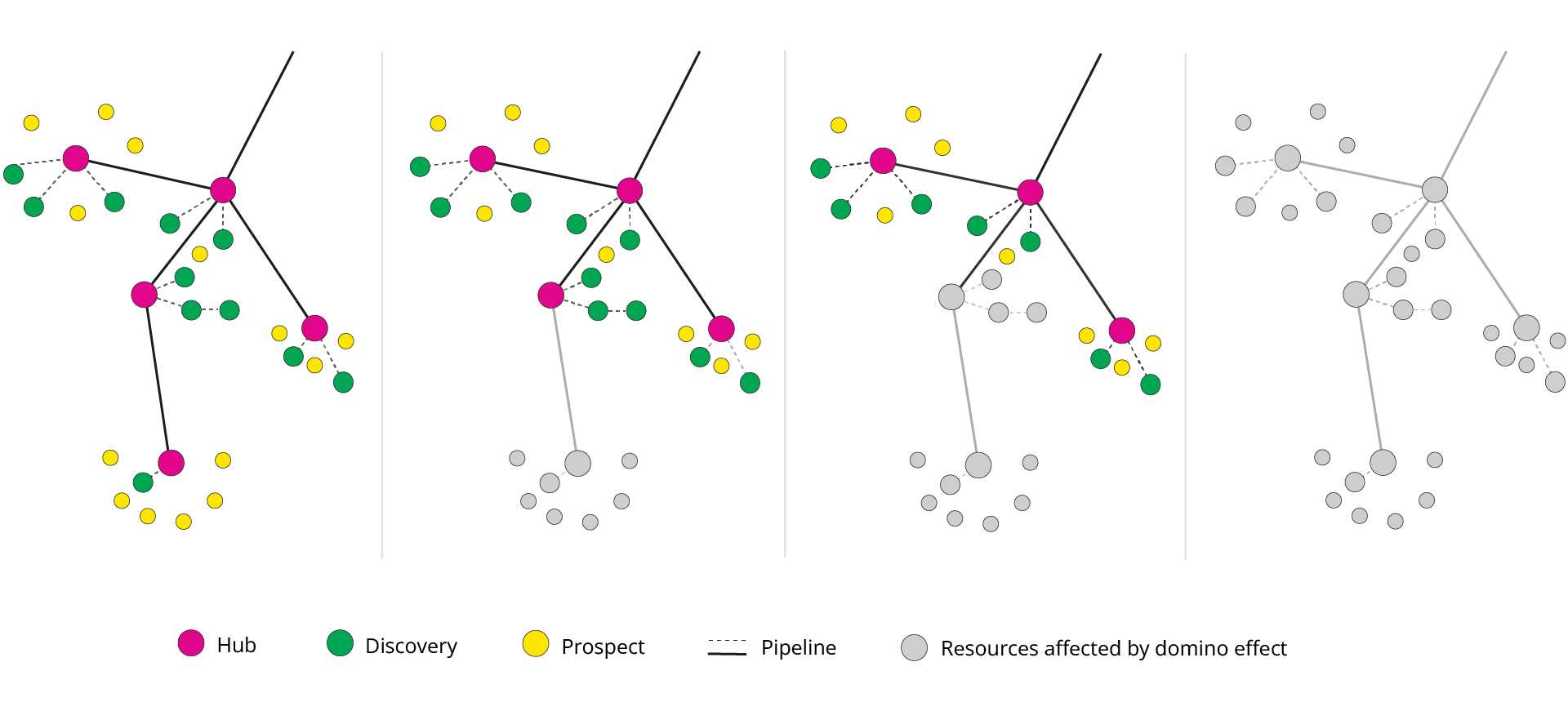
Chart: Interdependence and the domino effect.
The Base scenario cannot happen by itself. It requires robust willingness to invest, steady exploration activity and continuous technology investments throughout the entire period to be realised.
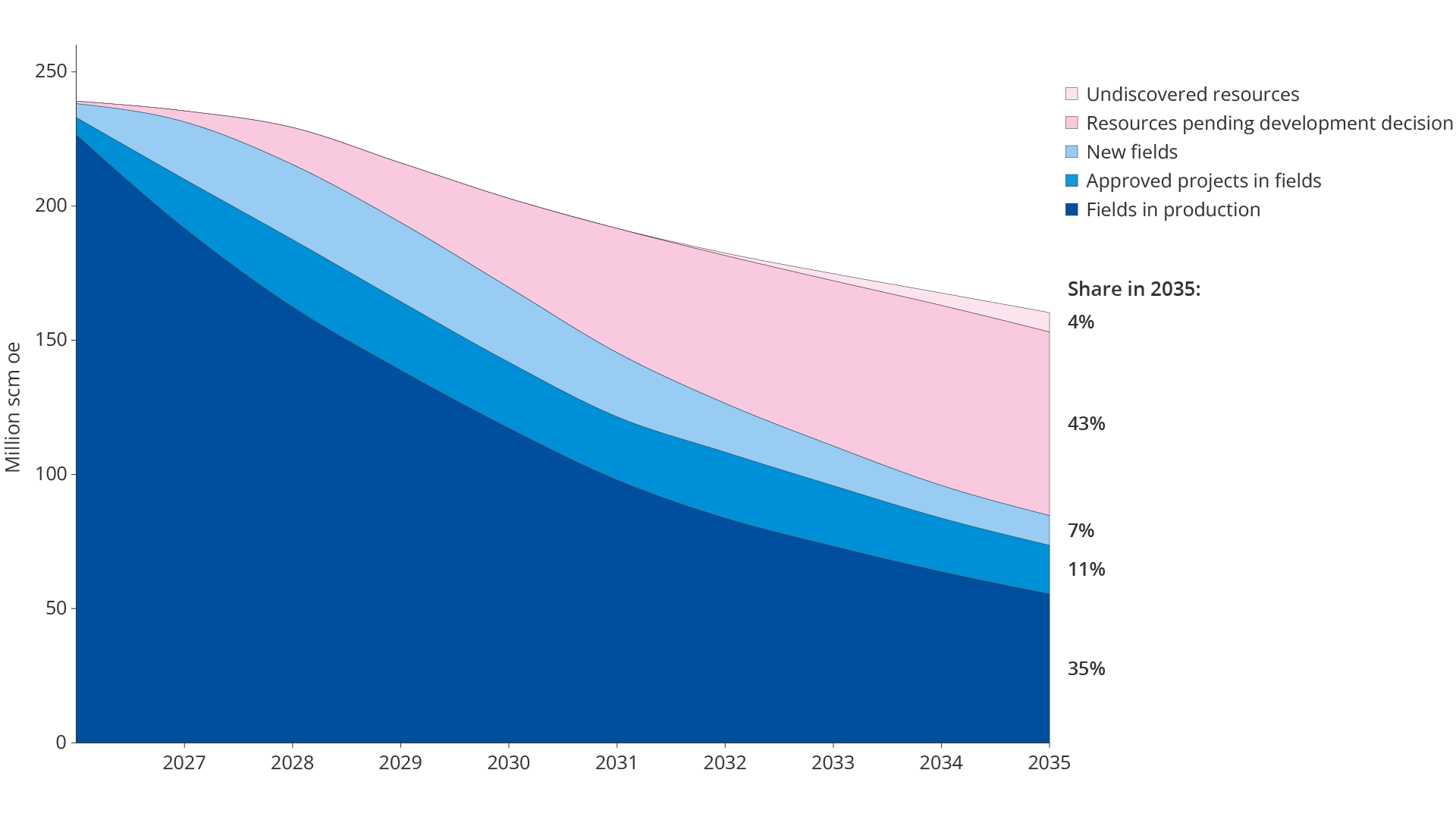
Figure: Production forecast (basic) by field, discoveries and undiscovered resources in the period 2026–2035.
The High scenario requires multiple sets of circumstances to develop positively and simultaneously. This requires high and stable exploration levels, good resource growth, also outside of the most mature areas, rapid technology development and industry players who are both willing and able to take risks over time.
Each one of these circumstances can succeed individually, but for them all to do so in unison and over a sustained period is more challenging. Opening up new areas can increase the probability of attaining the High scenario.
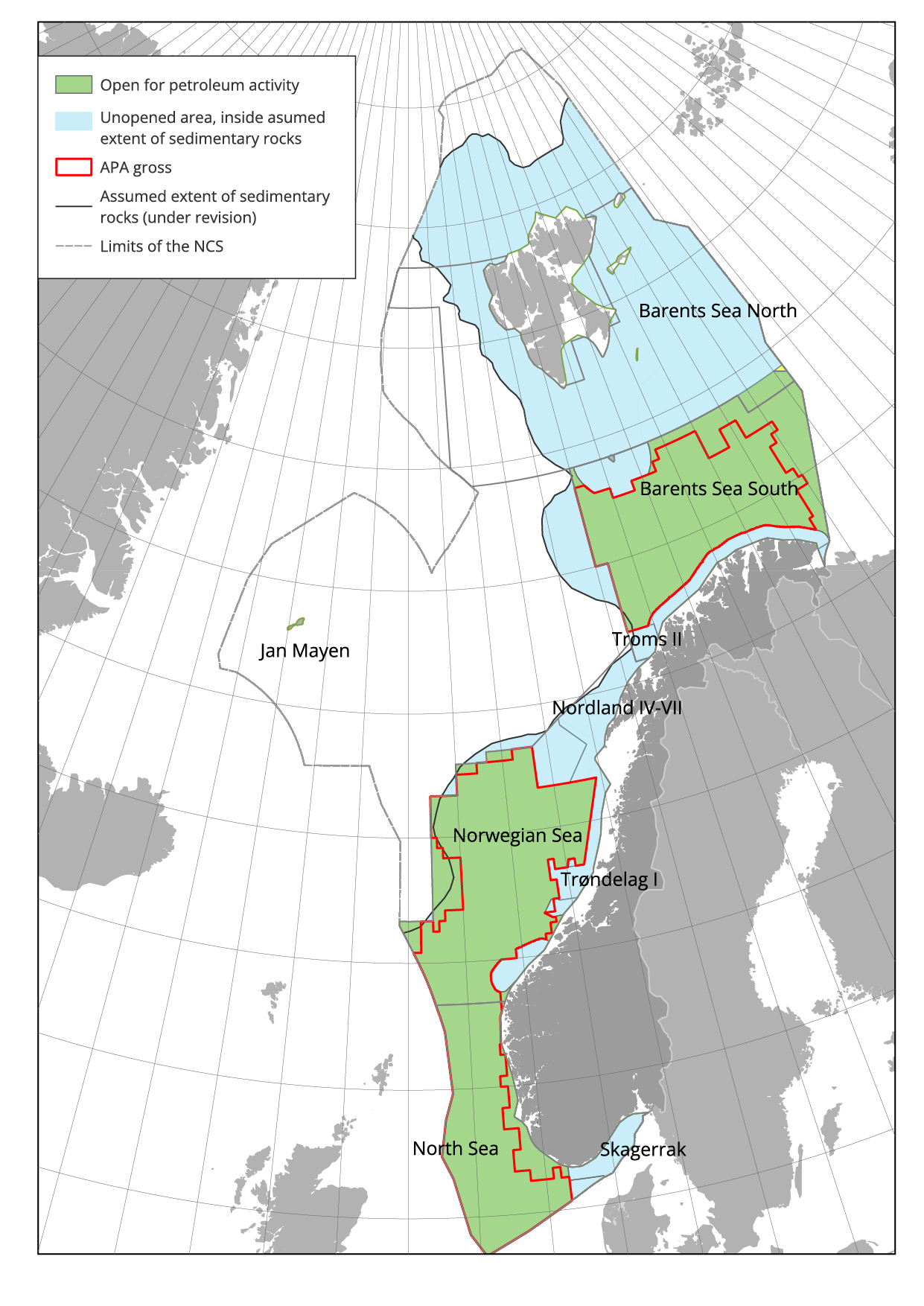
Chart: Area status on the Norwegian continental shelf
The difference between the scenarios is not down to coincidence, but to sound decisions and investments. The choices we make today are of profound significance to the future.
Read the full report (Norwegian only)
Source: Norwegian Offshore Directorate