According to mapping conducted by the Norwegian Offshore Directorate, cooperation between the companies, cost reductions and applying new technology can contribute to profitable production from tight reservoirs.
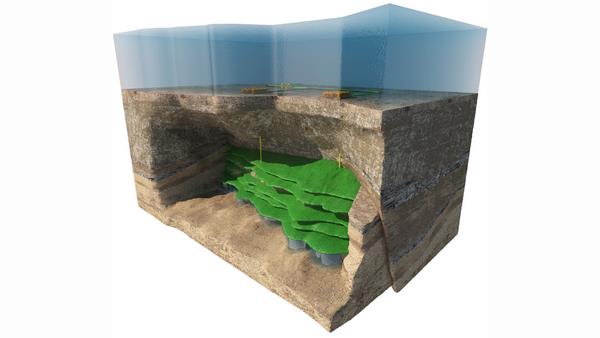
There are large quantities of oil and gas in so-called tight reservoirs on the Norwegian continental shelf (NCS). Many of the about 90 discoveries still awaiting a development decision are located in such tight reservoirs.
In order to extract these resources in a profitable way, the industry will need to improve cooperation, cut costs and apply more modern technology.
This is why it is urgent
'To achieve profitable production, we're dependent on existing infrastructure. In other words, this is time-critical,' says Arne Jacobsen, Assistant Director for Technology and Subsurface at the Norwegian Offshore Directorate.
Many discoveries remain undeveloped due to challenging reservoir properties and high risk. Profitability for these discoveries is also lower than for the reservoirs that have been produced so far.
On assignment from the Ministry of Energy, the Norwegian Offshore Directorate has mapped the status, challenges and potential measures needed to develop these resources.
Technology that can solve the problem
Several types of technology can lead to increased production from tight reservoirs:
Hydraulic fracturing involves fracturing the reservoir rock and keeping the fractures open by filling them with sand. This makes it easier for oil and gas to flow into the well, and increases the production potential.
Slim-hole drilling (thin-hole drilling) is a method used to drill wells with diameters that are smaller than usual. This means that the borehole is slimmer, and both the equipment and well structure are designed to be light and cost-saving.
Coiled tubing drilling is a drilling method where a continuous, long, flexible pipe is used instead of traditional, rigid drill strings that are screwed together part by part. During drilling, the coiled tubing is fed into the well as one long unit without seams. This makes the operation faster, more flexible and often cheaper.
CAJ technology (controlled acid jetting): Technology developed specifically to increase productivity in long horizontal wells where traditional methods have a limited range.
'Several of these technologies are well-tested elsewhere around the world. They aren't entirely new on the NCS, either, but are underused. We need more experience to improve our risk understanding and bring the costs down,' Jacobsen says.
Modelling and field studies of the Victoria, Warka, Sabina and Linnorm discoveries show that such technology could substantially increase the recovery rate. Many deposits with tight reservoirs were awarded in connection with APA 2025, for example Victoria in the Norwegian Sea. Technology such as hydraulic fracturing could be very important here.
Cooperation can yield significant results
The Norwegian Offshore Directorate has worked actively to increase competence and share experience through seminars, study trips and meetings with the largest operators and suppliers.
'The industry broadly agrees that more cooperation can result in better solutions overall. In turn, this can lead to necessary cost reductions. The supplier industry is also interested in bringing experience from other countries to the NCS', Jacobsen says.
Recommended measures
The Norwegian Offshore Directorate is recommending multiple measures to accelerate the development of tight reservoirs:
- Strengthening cooperation between relevant companies. This can often take place in a cooperative forum where participants share experience gained on the NCS and internationally.
- Relevant projects should be followed up systematically. Sharing production data and experience from wells where methods are used to improve recovery from tight reservoirs.
- Additional focus on technology development and skills development.
- Established cooperative bodies such as Force, national research centres within oil and gas, as well as Offshore Norge, can play important roles in exchanging experience and building competence.
Want to learn more?
You can find more information about tight reservoirs at sodir.no, including in The shelf in 2025 and Resource Report 2024.
Source: Norwegian Offshore Directorate