6603/12-1 (Gro) is one of the largest undeveloped gas discoveries on the Norwegian continental shelf (NCS). There is a considerable value creation potential here, but time is running out.
Gro* is located in the Norwegian Sea, about 160 kms from the Åsta Hansteen field and 350 kms west of Sandnessjøen.
'Gro has been left untouched in recent years. There's a time-limit on this, because the discovery needs to be tied back to the Åsta Hansteen field while we still have infrastructure in the area. In ten years, it could be too late,' says Arne Jacobsen, Assistant Director for Technology and Subsurface at the Norwegian Offshore Directorate
A major untapped discovery
There is significant uncertainty surrounding the size of the discovery, but early estimates from the Directorate indicated a very broad range, meaning 10–100 billion standard cubic metres (Sm3) of recoverable gas. The size has now been projected at about 52 billion Sm3 of gas in place.
'Gro is yet another in a long line of gas discoveries that remain undeveloped for various reasons. Many of them are in tight reservoirs, which makes production challenging,' Jacobsen says.
Shell discovered Gro in 2009, and the discovery was delineated in 2010. The seismic company TGS acquired a new data set in 2019. In 2021, the discovery was relinquished to the authorities from then-licensees Equinor and Wintershall. These efforts are based on both old and new seismic.
New study to kick-start Gro
In an effort to speed up the process, the Norwegian Offshore Directorate hired the consulting firm Terra Stream Energy to conduct a study of the discovery.
All relevant subsurface topics were assessed in the study, which shows three static models covering the volume range in the discovery. The study has resulted in geological models and a report that will be made available to companies on the NCS.
'This can shed light on how we understand Gro and give the industry access to static geo-models they can work to refine further,' Jacobsen explains.
He points out that a number of interesting discoveries have been made in the Vøring Basin and that there is extensive exploration activity in the area.
'How could Gro fit into a larger development of the area? The companies can use this study to evaluate the potential of the discovery on its own, or as part of an area solution. The next opportunity to apply is the upcoming round of awards in pre-defined areas (APA),' he says.
Working to develop untapped gas discoveries
The Norwegian Offshore Directorate is considering similar studies for other undeveloped gas discoveries on the NCS.
'We want to elevate discoveries without a production licence, many of which are in tight reservoirs. If the goal is profitable development, this will need to happen while the infrastructure is still in place. The NCS needs more experience with these recovery methods. If we can get the ball rolling on that, this will also reduce the cost of developing Gro,' Jacobsen says.
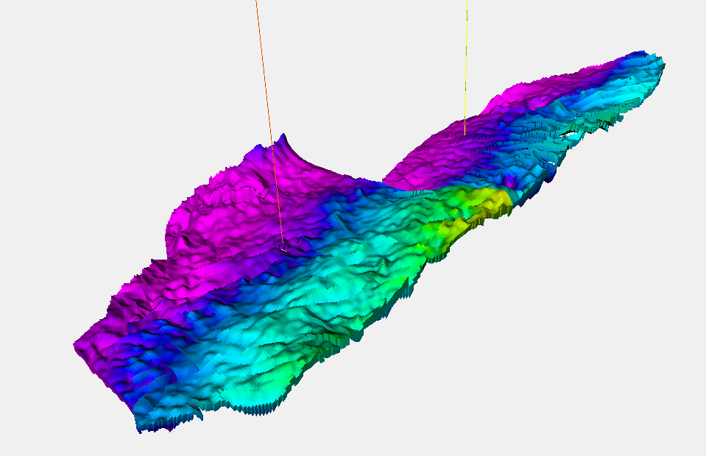
This is an illustration of the Gro structure. The colours indicate the elevation difference between the highest and lowest points of the structure. The scale goes from purple as the deepest to yellow as the shallowest. The line indicates exploration wells.
More information
Tight reservoirs: Profitable development of tight reservoirs
Untapped gas resources: Valuable gas resources untouched
If you want access to the models and report, please send an inquiry to postboks@sodir.no
*Gro is not the official name of the discovery, but is used here for ease of reference.
Source: Norwegian Offshore Directorate