
News listings

energy-pedia exploration

Norway flagNorway

Europe / Caspian / CIS >>> Norway

Norway: Young source rock proven common in the Norwegian Sea


06 Jan 2026

Photo - see caption

For the first time, a new scientific publication has documented a young source rock with widespread presence in the Norwegian Sea.

The presence of a source rocks is the number one prerequisite for forming petroleum. Documentation of a new source rock can create new exploration opportunities, particularly in areas with no previously known source rocks.

The Norwegian Offshore Directorate has been involved in studies of natural oil seeps on the NCS over several years. These studies have yielded new knowledge about a young source rock that, so far, has been overlooked.  

Photo - see caption
Geologist Rune Mattingsdal is co-author of the publication.

Published on ScienceDirect

In a new article on the online research platform ScienceDirect, much of the work is compiled and documented scientifically.

This publication links natural oil seeps west of Svalbard with proven Early to Middle Miocene (in this context, about 17 million years ago) intervals in several scientific boreholes and exploration wells in large parts of the Norwegian Sea (see map below).
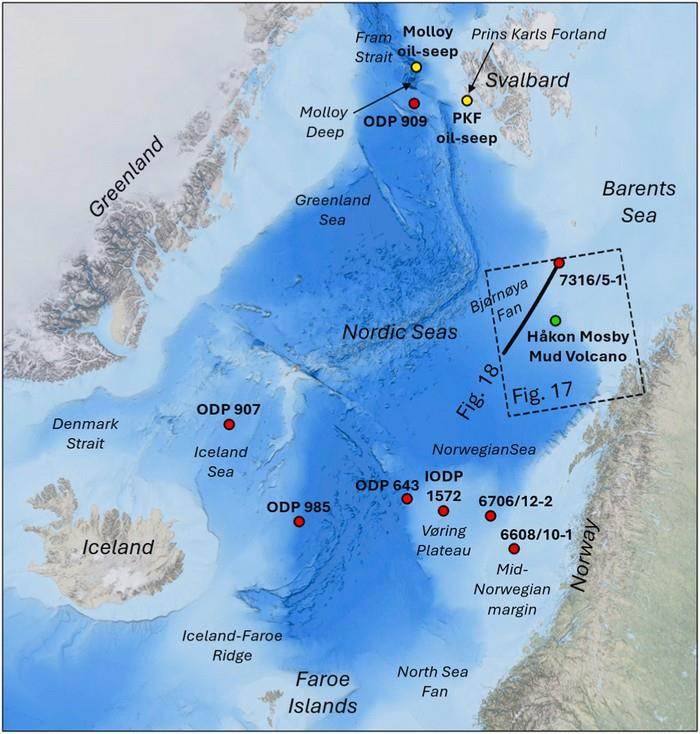
Photo - see caption
The map shows the two natural oil seeps west of Svalbard (yellow dots), and scientific boreholes and exploration wells where a young Miocene source rock has been proven (red dots).

Too shallow?

Basin modelling shows that this source rock can be oil-mature below the Bjørnøya Fan west of the Barents Sea.

'One of the most exciting results is that the studies document a young source rock from what used to be a large-scale deltaic sedimentary environment in large parts of the Norwegian Sea. The sedimentary conditions can best be compared with the conditions in the Niger and Congo deltas off the coast of West Africa'.

Those were the words of geologist Rune Mattingsdal at the Norwegian Offshore Directorate, who is a co-author of the publication.

Despite the fact that, in most places, the source rock will most likely be buried too shallow to form oil, it may, as is the case below the Bjørnøya Fan, potentially be buried deep enough to form hydrocarbons in several locations in existing APA acreage (APA, awards in pre-defined areas) in the Norwegian Sea, in areas that have not yet been explored with regard to this opportunity.

Original announcement link

Source: Norwegian Offshore Directorae


Bookmark and Share


A global information service for upstream oil and gas opportunities - divestitures, farmins and farmouts and licensing rounds.


Subscriber Only Deals

Current Deals

Current Upstream Deals: 195

Completed Deals

Completed Upstream Deals: 6640

Company Profiles

Current Company Profiles: 2933

Corporate Activity

Current Corporate Activity articles: 4197

Companies Looking

Current number of articles: 466

Company Sales

Current Company Sales articles:1674

Geostudies

Current Geostudies articles: 1003

How to subscribe

energy-pedia Jobs

RSS Feed Widget
See all jobs...


energy-pedia Databank

The energy-pedia databank contains links to information on the world financial and energy markets, including share prices, oil and gas prices and the global stock exchanges. Read more...


energy-pedia Glossary

A list of commonly used terms in the oil and gas industry. Read more...

Subscribe

Subscribe to the FREE
energy-pedia Daily Newsletter
Subscribe

Bayphase
OPC
energy365
Union Jack Oil 149
Merlin
Syntillica
Borchwix
Rose & Assocs
Telos NRG
About energy-pedia

energy-pedia news is a FREE news service written and edited by E and P professionals for E and P professionals.

We don't just report the news, we give you the technical background as well, with additional information derived from our unique energy-pedia opportunities service.
Contact us

energy365 Ltd

238 High Street
London Colney
St Albans
UNITED KINGDOM

Tel: +44(0)1727 822675

Email: info@energy-pedia.com