Accelerated technical work reduces key reservoir risk and supports progression toward exploration drilling
- Key exploration risk addressed, with integrated studies providing strong evidence for the presence of deepwater sand-rich reservoir systems across TEA-86
- Large-scale deepwater fan systems identified, comparable to those hosting major discoveries in Namibia, Guyana, Suriname and Angola
- Expedited technical work supports progression toward exploration Licence Contract conversion application and establishes a clear pathway toward drilling exploration well/s

Condor Energy has provided an update on the integrated subsurface technical studies across its Technical Evaluation Agreement (TEA-86) area in the offshore Tumbes Basin, Peru. The Company has accelerated its technical work programme under the TEA, delivering key geological and geophysical results ahead of schedule and supporting progression toward exploration Licence Contract conversion application.
Managing Director Serge Hayon commented:
'The latest phase of our work programme has addressed a key exploration uncertainty relating to the presence and distribution of deepwater reservoir systems, with results providing strong evidence for turbidite reservoirs across our acreage.
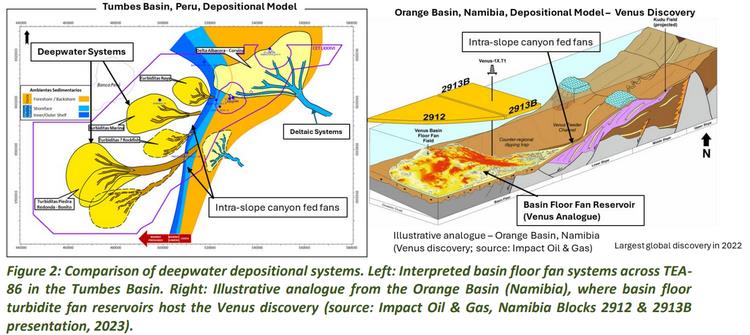
Through the integration of advanced seismic attribute analysis and geological studies, we have identified intra-slope canyon systems depositing deepwater fan reservoirs across large areas of TEA-86. These systems underpin many of the world’s most significant offshore discoveries, including those in Namibia, Guyana, Suriname and Angola, and materially enhance the potential of our exploration portfolio.
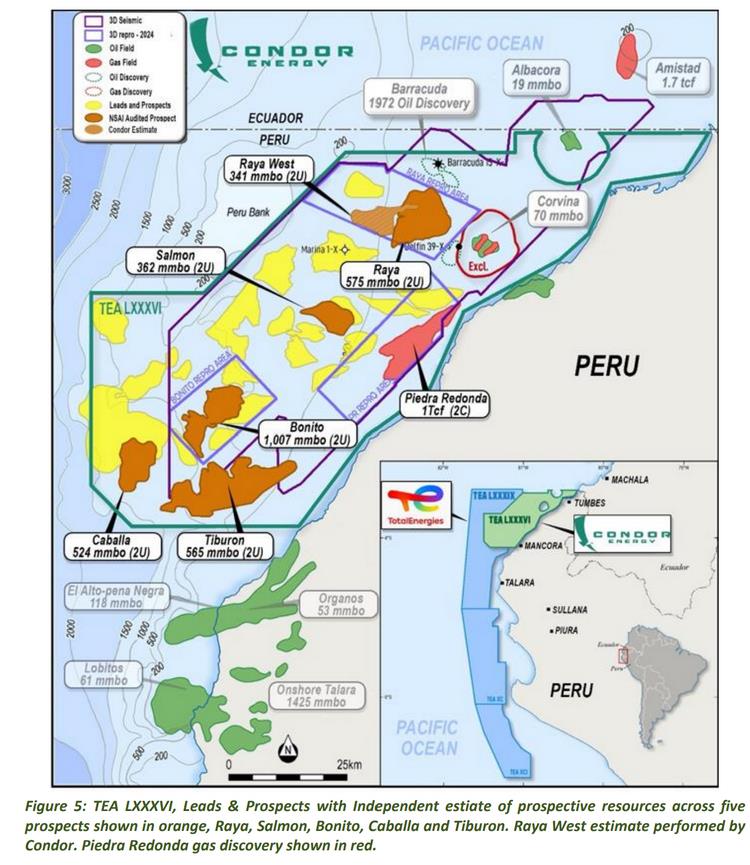
Importantly, this exploration upside is complemented by our Piedra Redonda gas discovery, which provides a clear pathway toward near-term commercialisation, positioning Condor to advance a balanced exploration and development strategy.'
KEY RESULTS – DEEPWATER RESERVOIR SYSTEMS IDENTIFIED
A key uncertainty in the exploration portfolio has been the presence and distribution of deepwater reservoir facies across the identified prospects. To address this, Condor has undertaken an integrated technical programme combining advanced seismic attribute analysis with geological and geophysical studies.
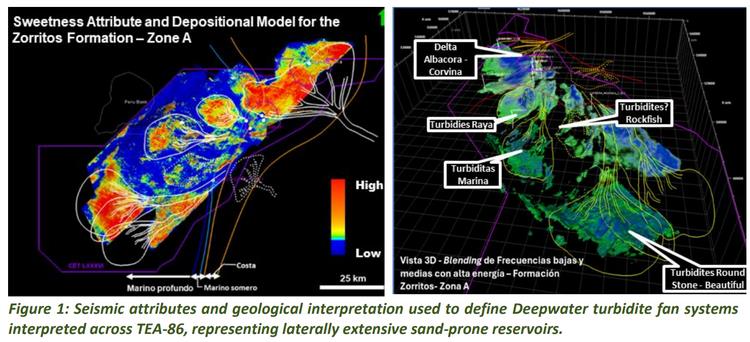
This work has identified basin-scale sediment transport systems and deepwater fan-style depositional geometries across TEA-86, interpreted as turbidite reservoir systems (Figure 1). Importantly, these depositional fairways extend across areas containing the Company’s existing exploration prospects, supporting the presence of sand-rich reservoirs directly overlying mature source rocks.
The identification of these depositional systems significantly reduces a key exploration uncertainty relating to reservoir presence and distribution across the portfolio.
Further technical detail on the integrated seismic and geological studies is provided in Appendix.
DEEPWATER ANALOGUE AND EXPORATION SIGNIFICANCE
Deepwater turbidite reservoirs have been the primary target of major offshore discoveries in basins such as Namibia, Guyana, Suriname and Angola. These depositional systems are directly analogous to those associated with recent world-class deepwater discoveries, including the Venus discovery offshore Namibia, where basin floor fan reservoirs are developed above mature source rocks and have been the focus of major offshore discoveries (see Figure 2). The identification of similar depositional systems within the Tumbes Basin highlights the relevance of these play types and supports Condor’s exploration strategy.
The scale of the interpreted depositional systems highlights the potential for large hydrocarbon accumulations within Condor’s offshore acreage. This work materially reduces a key exploration uncertainty relating to reservoir presence across the portfolio.
IMPLICATIONS FOR EXPLORATION AND PROSPECTIVITY
The identification of basin-scale depositional systems and reservoir fairways significantly enhances confidence in reservoir presence across Condor’s exploration portfolio. Importantly, these systems extend across areas containing the Company’s existing prospects, supporting the potential for large hydrocarbon accumulations. This work strengthens the geological framework underpinning Condor’s multi-billion barrel exploration portfolio and provides a clear technical foundation for advancing toward drilling.
The final component of the TEA work programme, consisting of 1D basin modelling, is currently underway. Completion of the work programme will support Condor’s application to convert the TEA into an exploration Licence Contract. An exploration Licence Contract represents a critical milestone, establishing a defined work programme and regulatory framework to progress exploration activities, including the drilling of exploration wells.
Source: Condor Energy