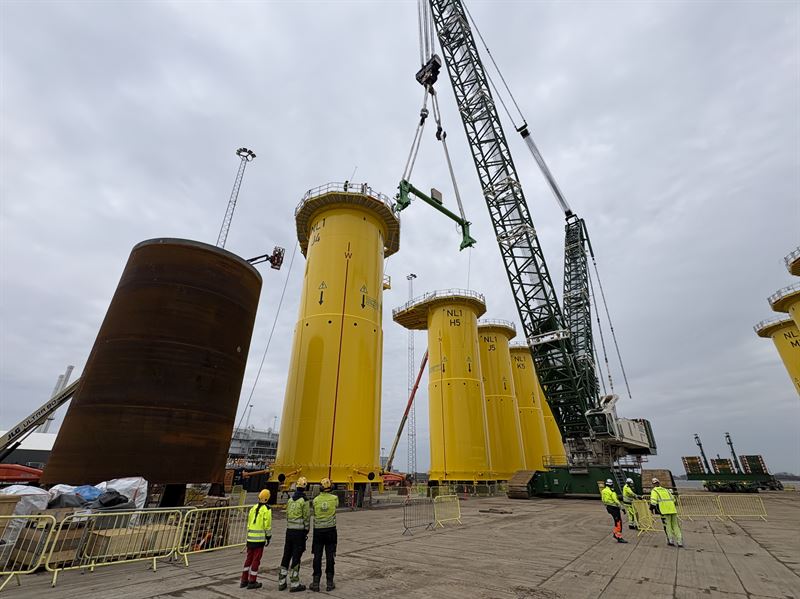
Vattenfall has launched an important preparatory step for the Nordlicht offshore wind farm. A so-called transition piece mock-up is currently underway at the site of supplier CS Wind Offshore in Aalborg, Denmark. This involves testing key installation, safety, and work processes on land before work begins at sea.
The transition piece connects the wind turbine tower to the foundation on the seabed. The transition pieces for Nordlicht I are manufactured by CS Wind Offshore, are approximately 23.7 meters high, and weigh about 362 tons. Installation requires complex lifting operations, precise procedures, and the coordination of various trades. As part of the mock-up, assembly, bolting, cable pulling and routing, as well as safety and rescue procedures, are tested under realistic conditions.
With the planned start of the offshore foundation construction for Nordlicht I in July 2026 – and for Nordlicht II approximately one year later – the implementation at sea is drawing closer. The monopiles, supplied by EEW, are up to 80.5 meters long and weigh up to 1,290 tons each. A total of 68 monopiles and transition pieces are planned for Nordlicht I. The onshore tests serve to identify risks early on, coordinate processes, and prepare the offshore construction phase safely and efficiently.
'This intensive preparation on land demonstrates the importance of close cooperation between our teams and partners. By testing interfaces, processes and safety aspects early on, we are creating the basis for a safe and efficient implementation of Nordlicht at sea,' says Manuel Fischer, EPC Director Nordlicht at Vattenfall.
In parallel, work has already begun in the German North Sea on so-called scour protection, in which rock piles protect the seabed against erosion at the future foundation locations.
Nordlicht is one of the largest offshore wind projects in Europe. According to current plans, the wind farms are scheduled to go into operation in 2028. Once fully operational, the Nordlicht cluster is expected to generate approximately 6 terawatt hours (TWh) of electricity annually.
The Nordlicht cluster is being built without government subsidies, thus representing a market-oriented expansion of renewable energies. With a net capacity of more than 1.6 gigawatts (GW), the project is among the most powerful offshore projects in Germany.
As part of Vattenfall's sustainability efforts, both wind farms use turbine towers that are partly made of low-emission steel, reducing the overall CO2 footprint by around 16 percent.
Attachments
- Release
- Mock Up Transition Piece
- Mock Up Transition Piece 2
- Mock Up Transition Piece 3
- Transition Pieces
- Transition Pieces
Source: Vattenfall