
As an island nation with more than 11,000 miles of coastline, the UK sits beside one of the most powerful, and most overlooked renewable energy resources on Earth: ocean waves. Offshore wind has dominated Britain’s clean-energy identity for decades, but wave power is no longer a distant prospect. It is now a proven, deployable technology whose moment has arrived. Across Europe, full-scale demonstrations have now fed reliable electricity into national grids, created skilled jobs in coastal communities, and strengthened industrial capability that any forward-thinking nation should want to anchor at home.
Recent shocks in global energy markets make the case for wave power even stronger. Once again, geopolitical tensions have sent oil and gas prices soaring, reverberating through the UK economy – raising fuel costs, feeding inflation, and forcing governments to intervene.
The memory of the £27 billion “Energy Price Guarantee,” introduced in the wake of the war in Ukraine, should still sting. Urgency for change has been recently underscored by the CCC’s, Climate Change Committee’s, new report highlighting how reaching net zero by 2050 is projected to cost less than the economic impact of a single major fossil-fuel price shock, such as Russia’s 2022 invasion of Ukraine, and this was before the Gulf Crisis started.
According to CCC analysis, the economic disruption from that single fossil-fuel shock may have exceeded four times the net annual cost of following a net-zero pathway, illustrating how reliance on imported hydrocarbons leaves the UK exposed to extreme economic volatility.
As Secretary of State Energy Security and Net Zero’s Ed Miliband has often emphasised, decarbonisation is not merely a climate obligation; it is a way to protect families and businesses from future price shocks.
When a single geopolitical flashpoint can upend the UK’s energy bills within days, it becomes impossible to ignore the fragility of relying on imported fossil fuels. If energy independence is truly a national priority, then accelerating domestic, predictable renewables, especially marine power, must be at the forefront.
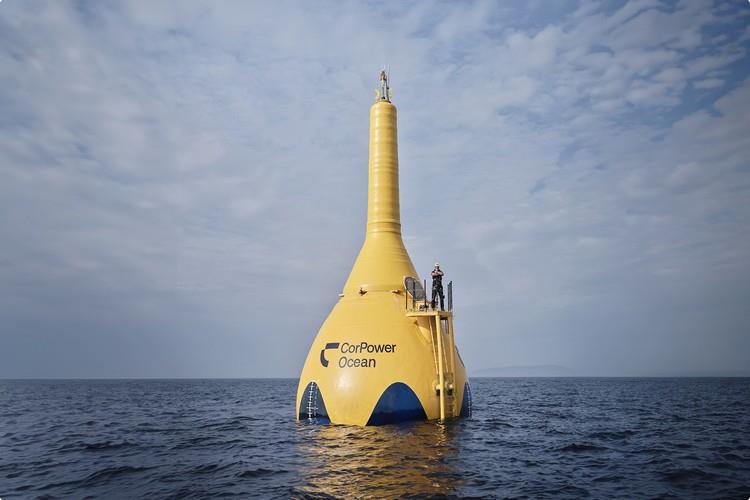
What makes this moment historic is that wave energy’s biggest hurdles have now been cracked. After decades of engineering and ocean testing, developers have solved the twin challenges that long held the sector back: surviving brutal storms and generating power efficiently. Among those leading this breakthrough is Swedish scale-up CorPower Ocean, which has successfully deployed devices and delivered grid power in Portugal. At the 2025 All Energy conference in Glasgow, Deputy First Minister Kate Forbes announced that CorPower had signed a berth agreement for a 5 MW wave array at European Marine Energy Center in Orkney is laying out the foundation for what could become over time the world’s largest wave farm. On top of that, a newly announced 2 GW project led by Argyll Infrastructure aims to use wave technology to power AI data centres, signalling the scale of industrial appetite now forming.
For the UK, the opportunity is enormous. By 2040, the marine energy sector could support tens of thousands of high-skilled jobs, rising to more than 80,000 by 2050. It could reinvigorate coastal towns, leverage Britain’s world-class maritime engineering heritage, build homegrown supply chains, and unlock new export markets. Wave energy is not merely a climate solution; it is an industrial strategy waiting to be seized.
Just as importantly, waves offer something wind and solar cannot: consistency. Driven by the vast and steady momentum of the Atlantic, ocean waves remain powerful even when the skies are dark, and the winds drop. They can forecast days or even weeks in advance. In winter, when the UK’s electricity demand peaks, wave energy reaches capacity factors comparable to nuclear power making it an ideal complement to existing renewables.
And its environmental footprint is remarkably light. Many devices sit low on the horizon or entirely below the surface, preserving coastal views and cultural heritage. With small seabed footprints and minimal noise, wave systems can integrate into marine ecosystems more gently than many alternatives.
Above all, wave energy is a sovereign resource. It cannot be embargoed, weaponised, or disrupted by global market volatility. It can help power remote island communities and feed the national grid with predictable, domestic electricity. In an uncertain world, it offers resilience in its most practical form.
For 20 years, the UK has been crucible of wave-energy innovation. While early commercial success proved elusive, the knowledge gained is now a national asset, one that can either be ignored or leveraged. Today, fully proven technologies are ready for commercial rollout. The UK can either shut the door or open it wide and lead the world.
With the economic consequences of fossil-fuel shocks, the argument for immediate investment in wave energy becomes even more compelling. The UK has the natural resources to reduce exposure to disruptive price spikes while gaining long-term economic, industrial and societal benefits.
To do so, policymakers must act. Ring-fenced Contracts for Difference (CfDs) partnered with targeted innovation programs have already shown how early support can unlock scale and sharply reduce costs as seen in offshore wind and solar PV. Wave energy is now poised for the same trajectory. But with CfD Allocation Round 8 approaching, hesitation is no longer harmless. Every month of delay risks ceding ground to nations already racing ahead.
The UK’s clean energy future will not be defined by one technology alone, but by a diverse portfolio that reinforces energy security, economic opportunity, and environmental integrity. Wave energy is long debated and finally now proven is ready to take its place. The Atlantic has thundered against British shores for millennia. The real question is whether Britain will now harness it, build the industry around it, and ride the crest of the next great renewable revolution.
We, The UK Marine Energy Council, Ocean Energy Europe, CorPower Ocean and Professor Henry Jeffrey, Head of Policy and Innovation Group, The University of Edinburgh, think it is the perfect storm to act now.
Source: CorPower Ocean