- Acquisition of Norway’s Skandi Connector establishes a dual-track installation system alongside PALOS
- Strengthened capabilities in offshore wind and long-distance interconnection, contributing to national grid stability and energy security
- Targeting global markets based on vertical integration spanning design, manufacturing, transportation, and installation

Taihan is enhancing its competitiveness in the submarine cable business by securing an additional large-scale Cable Laying Vessel (CLV).
On the 14th, the company announced the acquisition of the 10,000-ton class submarine cable installation vessel Skandi Connector. Following PALOS, the only offshore wind CLV currently owned domestically, this marks the second offshore wind-dedicated CLV introduced in Korea. The vessel is capable of loading up to 7,000 tons of submarine cable in a single operation.
With this acquisition, Taihan has strengthened its capabilities in both intra-array and export cable installation for offshore wind projects, while also establishing a system capable of executing long-distance interconnections and HVDC (High Voltage Direct Current) transmission networks. Notably, by operating two CLVs including PALOS, the company has established a dual-track installation system that enables optimal vessel deployment depending on project characteristics and installation environments.
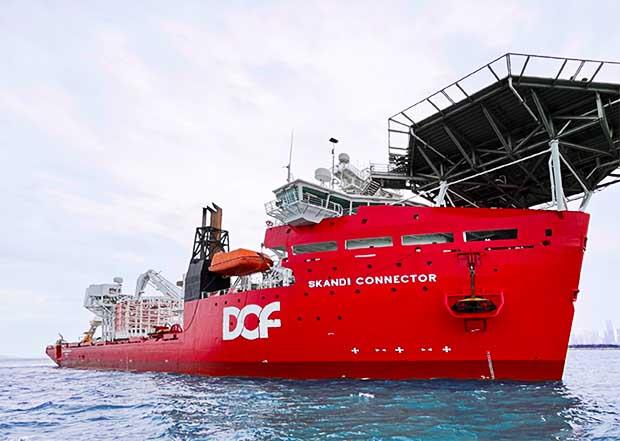
The Skandi Connector is a high-specification cable laying vessel designed by Damen, a Netherlands-based specialist shipbuilder, and previously operated by Norway’s DOF Group, a global marine engineering company. The vessel has been deployed in 27 projects, installing approximately 1,300 km of submarine cable, demonstrating proven safety and operational capabilities in global markets, including Europe.
Equipped with a DP2 (Dynamic Positioning 2) system, the vessel maintains precise positioning even under changing weather conditions. It also features high-spec installation equipment such as a large carousel and tensioners, enabling installation of export cables, long-distance interconnections, and short-distance HVDC submarine cables.
The vessel’s flat-bottom hull enables stable operations in shallow waters, making it particularly suited for Korea’s coastal areas such as the West Sea, where tidal currents are strong and depths are relatively low. With a self-propelled speed of up to 12 knots, it offers superior operational stability and efficiency compared to Cable Laying Barges (CLBs), which require tug assistance.
Through this acquisition, Taihan has established a CLV fleet capable of covering the full spectrum of submarine cable installation. This strengthens its vertically integrated system, enabling in-house execution of the entire value chain from design and manufacturing to transportation and installation. In particular, synergies with its Submarine installation subsidiary, Taihan Ocean Works, are expected to enhance turnkey competitiveness and expand project execution capabilities.
This investment is particularly significant amid surging global demand for large-scale cable laying vessels driven by the expansion of offshore wind and increased cross-border grid investments. By securing a high-spec CLV available for immediate deployment instead of newbuild construction, Taihan improves responsiveness and operational stability while proactively addressing supply-demand imbalances in installation vessels. It is also expected to reduce reliance on foreign vessels, thereby contributing to the stability of domestic power grid projects and strengthening energy security. The company also plans to expand business opportunities through both fleet operations and vessel chartering.
A company official stated, 'With the additional CLV, we have established a system capable of executing both offshore wind projects and long-distance interconnections simultaneously. Leveraging PALOS and Skandi Connector, we will continue to strengthen our competitiveness in the global submarine cable market through stable project execution.'
Taihan signed the vessel purchase agreement with DOF on the 14th, and delivery to Korea is scheduled for August.
Source: Taihan